Sports betting markets opening at different times

Why Betting Markets Open at Different Times: A Guide to Sports Betting Market Timing

Sports fans often notice that betting markets do not all become available at the same time. One football match may have several markets listed days before kickoff, while another may only show basic options shortly before the event. Cricket markets can behave differently again, with some becoming available well before the toss and others appearing closer to the start of play.

This timing is not random. Betting markets are opened according to factors such as the sport, event schedule, available information, market liquidity, data quality, and the level of risk involved in pricing a particular outcome. Understanding these factors can make sports markets easier to follow, even for people who are simply interested in how odds work.

What Does It Mean When a Betting Market Opens?

A betting market is considered open when an operator makes a particular betting option available with current odds or prices.

For example, a football match may initially offer a simple match-winner market. As more information becomes available, additional markets may appear, including totals, handicaps, player-related options, and other match-specific selections.

The opening time therefore depends on how confidently an operator can price the market and whether sufficient information is available.

Some operators publish markets well before an event, while others wait until closer to the scheduled start. This difference is one reason users may see different availability across sports and platforms.

1. The Sport Has a Major Influence

Every sport has its own information cycle.

Football matches often have confirmed schedules, team news, player statistics, and competition information available well in advance. This makes it possible for operators to begin pricing certain markets earlier.

Cricket can be more complicated. Playing conditions, toss results, final team selections, pitch information, weather, and format-specific factors can all influence expectations. As a result, some cricket markets may change significantly closer to the start of a match.

Tennis, basketball, baseball, and other sports also have their own patterns. The more important information that is still unknown, the more cautious operators may be about opening certain markets.

2. Team News and Player Availability Matter

One of the biggest reasons for delayed market openings is uncertainty around participants.

An injury, suspension, squad announcement, starting lineup, or late player withdrawal can significantly change expectations. If an important player is not confirmed, pricing a player-specific or performance-related market becomes more difficult.

Operators may therefore open broad markets first and introduce more detailed markets after important team or player information becomes available.

This approach helps ensure that the prices being displayed are based on reasonably current information rather than assumptions that could quickly become outdated.

3. Data Availability Affects Market Timing

Modern sports markets rely heavily on data.

For live and pre-match markets, operators can use information such as historical performance, player statistics, team news, event schedules, weather information, and real-time match feeds.

The UK Gambling Commission’s guidance on in-play betting explains that operators use real-time sports data to revise prices, suspend markets, and settle bets accurately.

If reliable information is not available, a market may be delayed, limited, or temporarily suspended.

4. Liquidity Is Another Important Factor

Liquidity refers broadly to how much activity and available money exists within a market.

Popular sporting events generally attract more attention, which can support a wider range of markets. Smaller competitions may have fewer markets because there is less trading activity and potentially less reliable information.

This is why a major international football tournament may have extensive markets available well before kickoff, while a lower-profile fixture may have fewer options until closer to the event.

Market depth can also affect how quickly prices respond when new information arrives.

5. Live Markets Require Much Faster Updates

Pre-match markets and live markets operate very differently.

Once a match begins, information can change within seconds. A goal, wicket, red card, injury, penalty, boundary, or other major event can immediately affect the expected outcome.

The UK Gambling Commission notes that in-play prices can be amended continuously according to information and liabilities held by licensed betting companies.

This is also why live markets may briefly disappear. A market can be suspended when an important event is taking place or when the operator needs to update its pricing.

For example, during cricket, a market may be suspended around a delivery where a wicket, review, or other significant development could affect the outcome.

6. Why Some Markets Open Earlier Than Others

Not every market carries the same level of uncertainty.

A basic match-result market may be relatively straightforward to price because it depends on a limited number of broad outcomes. More detailed markets can require additional information.

Player performance markets are a good example. If a player’s participation has not been confirmed, a market involving that player may remain unavailable.

Similarly, markets connected to specific match events may be introduced closer to the start when the relevant information becomes clearer.

This creates a staggered opening process rather than a single opening time for every market.

7. Opening Odds Can Change Before the Event

Another important point is that the first available price is not necessarily the final pre-match price.

As new information enters the market, odds can move. Team announcements, injuries, weather developments, public interest, and changes in market activity can all contribute to price movements.

Singapore Pools, for example, explains that opening odds are the odds offered at the start of sales and that odds may change as the match or event progresses.

This demonstrates why market timing and price movement are closely connected.

How Can Sports Fans Follow Market Timing?

People interested in sports markets can make the process easier by following the event schedule and checking when different markets become available.

It is also useful to understand the difference between:

  • Pre-match markets: Available before the event starts.
  • Opening markets: The first markets and prices released by an operator.
  • Expanded markets: Additional options introduced as more information becomes available.
  • Live markets: Markets updated while the event is taking place.
  • Suspended markets: Temporarily unavailable while prices or event information are being updated.

For those exploring sports betting information, a platform such as Cricbet99 can be used as a reference point for cricket and wider sports-related content, although availability of markets and services can vary by location and applicable regulations.

Frequently Asked Questions

Why do betting markets open at different times?

Markets open at different times because sports, events, data availability, participant information, liquidity, and pricing risks vary. Operators may wait for reliable information before releasing certain markets.

Do all markets open before a match?

No. Some basic markets may open early, while more detailed markets can become available later. Certain markets may only appear shortly before the event or after additional information is confirmed.

Why are live betting markets sometimes suspended?

Markets can be suspended when a major event occurs or when the operator needs time to receive and process updated information. This helps ensure that displayed prices reflect the current state of the event.

Can opening odds change?

Yes. Opening odds can change as new information and market activity influence pricing. Team news, injuries, weather, and match developments can all contribute to movement.

Does every sport have the same market schedule?

No. Each sport has different information requirements and event structures. Cricket, football, tennis, and other sports can therefore have different market-opening patterns.

Final Thought

The different opening times of betting markets are largely a result of how sports information becomes available. Operators need reliable data, participant information, event details, and appropriate pricing models before offering particular markets.

Understanding this process also explains why some markets appear days ahead of an event while others arrive shortly before kickoff or start time. Live markets add another layer because prices must react rapidly to events as they happen.

For anyone following sports markets, the key is to understand that market availability and odds are dynamic rather than fixed. Checking event information, understanding market types, and being aware of local rules can provide a clearer picture of why markets open when they do. Where betting is legal, users should also follow applicable regulations and maintain responsible gambling habits.

Different sports market settlement rules explained

Why Different Sports Have Different Market Settlement Rules

Sports markets may look similar at first glance, but the rules used to settle them can vary significantly from one sport to another. A football match, cricket game, tennis match, basketball fixture, or baseball game each has its own structure, scoring system, match duration, and rules for handling interruptions. These differences make sports market settlement rules an important topic for anyone who follows sports markets online.

Understanding settlement is not simply about knowing which team won. It also involves knowing when a market is considered final, whether extra time counts, what happens when a player retires, and how postponed or abandoned matches are handled. Different sports require different approaches because their competitive formats are fundamentally different.

What Are Sports Market Settlement Rules?

Market settlement rules explain how an outcome is determined after a sporting event or a particular market has finished. They establish which official result is used, what part of the event counts, and what happens when circumstances prevent a normal conclusion.

For example, a football market may be settled using the result after 90 minutes plus stoppage time, while extra time and penalties may be excluded unless the market specifically says otherwise. Some sportsbook rules also state that an abandoned match can make undecided markets void while markets that have already been conclusively determined may still stand.

This is why reading the specific rules for a market can be just as important as understanding the sport itself.

Why Does Each Sport Need Different Rules?

1. Different Match Formats

The biggest reason is that sports do not have the same format.

Football normally has two halves and a defined regulation period. Basketball is divided into quarters and may include overtime. Tennis is played through sets and games, with matches potentially ending early because of retirement. Cricket can involve different formats, including Test matches, ODIs, and T20 games.

Because the structure differs, a universal settlement rule would not work effectively.

2. Extra Time and Overtime Can Change the Outcome

Extra periods are another major factor.

In football, the result after regulation time can be different from the eventual result after extra time or a penalty shootout. Therefore, markets must clearly state whether these additional periods are included.

Basketball presents a different situation because overtime is often an integral part of determining the final winner. Some sport-specific rules include overtime in certain markets while excluding it from others.

This distinction becomes particularly important when comparing winner, handicap, totals, and period-specific markets.

3. Abandoned and Postponed Matches

Weather, technical problems, injuries, crowd issues, or other unexpected circumstances can interrupt sporting events. Settlement rules need to explain what happens when a match does not reach its normal conclusion.

There is no single universal timeframe across every sportsbook. For example, some rules use a 48-hour continuation window, while other operators use different periods. Markets that have already been unconditionally determined may sometimes remain settled even when the overall event is abandoned.

This is one reason responsible sports-market users should check the applicable rules instead of assuming every operator follows the same procedure.

Cricket Has Its Own Settlement Considerations

Cricket is an excellent example of why sport-specific rules are necessary.

A cricket match can be affected by rain, reduced overs, interruptions, innings changes, player participation, and different competition formats. A T20 match, for example, has a very different structure from a Test match.

Settlement can therefore depend on the market itself. A match-winner market may require an officially declared result, while a player or innings market may have separate conditions.

For people researching Sports markets, understanding the difference between the sport’s official result and an individual market’s settlement conditions can prevent unnecessary confusion.

The official Cricbet99 sports platform also covers multiple sports and market-related information, making the distinction between sports formats particularly relevant when exploring different competitions. The platform itself advises users to consider applicable local laws and use its services responsibly.

Tennis Settlement Is Different Again

Tennis introduces another unusual situation: player retirement.

A tennis match can end before the scheduled number of sets has been completed. Depending on the market and applicable rules, a retirement may result in a market being void, while a market that has already been completely determined may be treated differently.

This shows why simply looking at the scoreboard is not always enough. Settlement depends on the exact market definition and the rules attached to it.

Official Results Matter

Another common principle is the use of an official result from the relevant governing body or competition authority.

Sportsbooks may initially settle a market using available information, but rules can allow a settlement to be corrected if the official result later changes. Betfair, for example, explains that markets can be resettled when an official result differs from the result initially used for settlement.

That principle is important because sporting outcomes can occasionally be affected by official reviews, corrections, or disciplinary decisions.

Why Market-Specific Rules Matter

Even within the same sport, two markets can have completely different settlement conditions.

Consider a football match. A full-time result market, first-half market, total-goals market, and first-goalscorer market are measuring different events. A match being abandoned does not necessarily affect all of them in exactly the same way.

Some rules state that markets whose outcomes were already fully determined can stand even if the overall match is later abandoned.

For that reason, users should always check the market description and the operator’s specific settlement policy before relying on an assumed interpretation.

How to Understand Settlement Rules More Easily

A simple approach is to check five points:

  1. What is the official result?
    Identify which governing body or competition authority determines the final outcome.
  2. What period counts?
    Check whether regulation time, overtime, extra time, or penalties are included.
  3. What happens if the event is interrupted?
    Look for rules covering postponement, suspension, and abandonment.
  4. Are player participation requirements involved?
    This can be especially relevant to player-specific markets.
  5. What happens if the result changes later?
    Check whether the operator can resettle a market following an official correction.

These five questions provide a useful framework for understanding most settlement policies.

FAQs

Why do sports have different settlement rules?

Every sport has a different format, scoring system, duration, and method of determining a winner. Settlement rules are designed around those characteristics.

Does extra time always count?

No. Whether extra time or overtime counts depends on the sport and the specific market. Always check the market’s stated conditions.

What happens when a match is abandoned?

It depends on the applicable rules. Undecided markets may be void, while outcomes that were already conclusively determined may sometimes stand.

Why are official results important?

Official governing-body results provide an authoritative basis for settlement and can also determine whether a market needs to be resettled after a correction.

Are settlement rules the same on every platform?

No. Operators can have different general and sport-specific policies. Comparing the published rules is therefore important.

Final Thought

Different sports need different market settlement rules because no two sports determine results in exactly the same way. Match duration, overtime, player participation, weather interruptions, retirements, official decisions, and competition formats can all influence how a market is settled.

The most reliable approach is to understand the sport first and then read the specific settlement conditions attached to the market. For anyone exploring Sports markets, this habit provides a clearer understanding of how results are determined and helps avoid assumptions when unusual situations occur.

Ultimately, settlement rules are designed to bring consistency to situations that are often unpredictable on the field. Understanding them makes following sports markets more transparent, informed, and responsible.

Pre-event odds vs closing odds in sports betting market

Understanding Pre-Event Odds vs Closing Odds in Sports Betting

Sports betting markets can change significantly between the moment odds are first published and the start of an event. A team that opens at one price may be available at very different odds shortly before kickoff. For bettors trying to understand how markets work, this movement raises an important question: what is the difference between pre-event odds and closing odds, and why does it matter?

The answer becomes clearer when you look at how information enters a sports market. Team news, injuries, confirmed lineups, weather, public betting activity and professional money can all influence prices before an event begins. The closing odds represent the market price at the end of that process, while pre-event odds describe prices available earlier in the buildup.

Understanding the difference can help readers interpret odds movement without assuming that every price change automatically represents a winning opportunity.

What Are Pre-Event Odds?

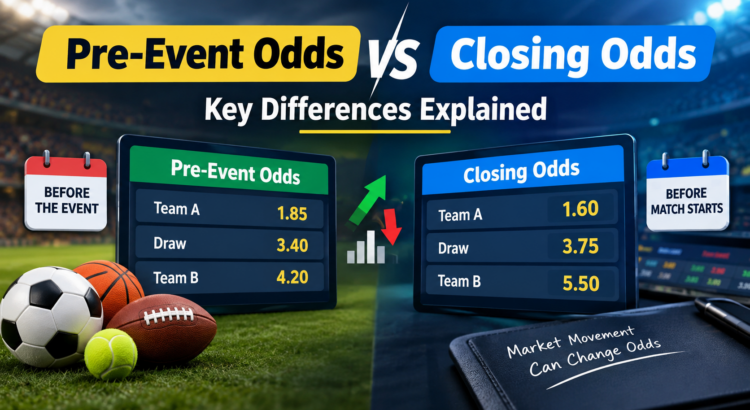
Pre-event odds are the prices available before a sporting event starts. They can appear hours or even days before the scheduled start, depending on the sport and market.

At this stage, bookmakers and betting markets are working with the information available at that particular moment. For example, a cricket match may initially be priced using team strength, recent performances, player statistics, venue conditions and historical results.

Suppose a hypothetical cricket match opens with:

  • Team A: 1.90
  • Team B: 1.90

The market initially views the two sides as relatively evenly matched. However, these prices are not necessarily fixed. As more information becomes available, the market can adjust.

For anyone comparing sports betting odds, the important point is that an early price is simply a snapshot of the market at a particular time.

What Are Closing Odds?

Closing odds are the final available prices immediately before the event begins. They are often used as an important reference point because they incorporate information and market activity that occurred after the initial prices were released.

Imagine Team A’s odds move like this:

Opening price: 1.90
Several hours before the match: 1.80
Just before the start: 1.65

The 1.65 price is the closing figure in this simplified example.

The movement suggests that the market’s assessment of Team A changed during the pre-match period. That could happen because of a confirmed lineup, an injury, changing weather conditions or significant betting activity.

Importantly, closing odds should not be treated as a guaranteed prediction. They are a market price, not a statement that an outcome will definitely happen.

Why Do Odds Move Before an Event?

There is rarely just one reason for a change in odds.

Team news can have an immediate effect. If an important player is ruled out, the market may reassess the team’s chances.

Weather conditions can also matter. This is particularly relevant to cricket, where rain can influence match duration, pitch conditions and strategies.

Confirmed lineups provide information that was unavailable when early prices were released. A strong player returning to the starting XI, for example, can influence market expectations.

Betting activity is another factor. When substantial money enters a market, prices may move as bookmakers and other market participants adjust their positions.

This is why an odds screen can look noticeably different on match day compared with when the market first opened.

Pre-Event Odds vs Closing Odds: A Simple Example

Consider a fictional football match.

A team is initially offered at 2.40. Later, the price moves to 2.10, and finally closes at 1.95.

Someone who took 2.40 obtained a different price from someone who waited until just before the event.

The change does not prove that the first bettor will win. The team could still lose. Instead, it shows that the market moved toward a shorter price after the original bet was placed.

This concept is closely related to closing line value (CLV), which compares the price accepted on a bet with the market’s closing price. A bettor who consistently receives a better price than the eventual close may be demonstrating that their timing or price selection has produced an advantage relative to the later market benchmark.

Why Closing Odds Matter When Studying Betting Performance

Looking only at wins and losses can sometimes give an incomplete picture.

Imagine someone makes ten bets and wins six. That sounds positive at first, but the result alone does not explain whether the prices they received were strong.

Comparing the original odds with closing odds provides another way to evaluate decision-making.

For example, if a bettor repeatedly takes a team at 2.20 and the market later closes around 2.00, those bets consistently beat the closing price. Conversely, regularly taking 2.00 before the market closes at 2.20 indicates the bettor was receiving a less favorable price than the eventual market benchmark.

Research and betting-market analysis commonly use closing prices as a reference, although the closing number should not be interpreted as a perfect measure of true probability. Different operators can have different margins, liquidity and pricing.

Should Bettors Always Wait for Closing Odds?

Not necessarily.

Waiting can provide access to more information, but it can also mean missing an earlier price. If the market moves significantly, the later price may be less attractive.

On the other hand, betting early carries more uncertainty because important information may not yet be available.

There is therefore no universal rule that early or late betting is always better. The more useful approach is to understand why odds move and compare prices within the same market and conditions.

For beginners, this also means avoiding the assumption that a shorter closing price automatically makes the original selection a winner. Sports remain uncertain, and even a well-priced bet can lose.

How to Track Odds Movement

Anyone interested in studying pre-event and closing prices can keep a simple record.

Note the initial price, the time it was available, the price when the bet was placed, and the eventual closing price. Over a larger sample, this can reveal whether decisions were consistently made at prices that later moved in a favorable direction.

It is also important to compare the same market. A match-winner price should not be compared with a handicap or a different settlement condition.

For cricket, additional factors such as the playing XI, toss, pitch report and weather can make timing especially relevant because new information can change market expectations quickly.

Frequently Asked Questions

What is the difference between pre-event odds and closing odds?

Pre-event odds are prices available before a sporting event starts, while closing odds are the final prices available immediately before the event begins.

Why do closing odds change from the opening price?

Odds can move because of injuries, team news, lineups, weather, betting activity and other information entering the market.

Are closing odds always more accurate?

Closing odds incorporate more information and are widely used as a market benchmark, but they are not guaranteed to represent the true probability of an outcome.

What does closing line value mean?

Closing line value compares the odds taken by a bettor with the eventual closing price. It is commonly used to assess whether someone consistently obtained better prices than the market close.

Can a bet lose but still have positive closing line value?

Yes. CLV evaluates the price compared with the closing market, not whether an individual bet won or lost. A selection can lose despite having been placed at a better price than its closing odds.

Final Thought

Pre-event odds and closing odds provide two different snapshots of the same sports market. The first reflects what the market believed with the information available earlier, while the second reflects where prices settled after additional information and betting activity had influenced the market.

For anyone studying sports betting, comparing these two points can offer a clearer understanding of odds movement and market behavior. It should not be viewed as a guarantee of future results, but rather as one useful way to examine how prices change before an event begins.

For readers looking to strengthen their understanding of pricing, probability and market movement, sports betting odds provide a useful starting point before moving into more advanced concepts such as closing line value.

Why Odds Move Before a Sporting Event Begins

Why Odds Move Before a Sporting Event Begins

If you have ever checked the odds for a football, cricket, tennis, or basketball event more than once, you may have noticed something interesting: the numbers do not always stay the same. A team that was priced at 2.10 in the morning could be available at 1.85 later in the day, even though the match has not started yet.

This is known as odds movement, and it is a normal part of sports betting markets. Odds can change because of new information, team news, weather conditions, betting activity, market expectations, and adjustments made by sportsbooks.

Understanding why these changes happen can make sports betting markets easier to read and can help bettors avoid assuming that every movement is a guaranteed prediction.

What Does Odds Movement Mean?

Odds movement simply refers to a change in the price offered on a particular outcome.

For example, imagine a football team opens at odds of 2.20 to win. A few hours later, the odds fall to 1.95. The shorter price suggests that the market now considers that outcome more likely than it did when the original odds were posted.

The opposite can also happen. If the odds move from 2.20 to 2.60, the price has drifted, indicating that the market’s assessment has changed in the other direction.

However, an important point is that odds movement does not guarantee the final result. It reflects changing market expectations, not certainty.

Why Do Odds Change Before a Match?

Several factors can influence sports betting odds before an event begins.

1. Team News and Player Availability

One of the biggest reasons for pre-match odds movement is new information about players.

An important striker being ruled out before a football match can affect a team’s attacking strength. In cricket, the absence of a leading batter or bowler can change the expected balance between two teams.

Similarly, a late return from injury or confirmation that a key player will start can cause the odds to move in the opposite direction.

Sportsbooks constantly monitor these developments because player availability can have a direct impact on the expected outcome.

2. Starting Lineups

Confirmed lineups can create significant movement, particularly in sports where individual players have a major influence.

Before lineups are announced, sportsbooks have to account for uncertainty. Once the starting XI or lineup becomes official, some of that uncertainty disappears.

This is one reason odds can change noticeably shortly before kickoff or the start of play.

3. Weather Conditions

Weather is another factor that can influence betting markets.

Heavy rain, strong wind, extreme heat, or other unusual conditions may affect how a sporting event is expected to play out.

For example, poor weather may influence football scoring expectations, while rain can have a particularly important effect on cricket because of playing conditions and the possibility of interruptions.

As forecasts become more reliable, sportsbooks and market participants can adjust their expectations accordingly.

4. Betting Activity and Money Flow

Odds are also affected by betting activity.

When significant amounts of money are placed on one outcome, the sportsbook may adjust its price as part of its risk management. This does not necessarily mean that everyone betting on that outcome has superior information.

Popular teams can attract substantial public betting simply because they have a large fan base. Therefore, it is important not to assume that every odds move represents expert opinion.

Marketplaces and sportsbooks also pay attention to broader price movements, which can cause one operator to react after another changes its odds.

5. New Information From the Sporting World

Sometimes the reason behind a price change is obvious. At other times, it may not be immediately visible.

News about injuries, suspensions, tactical changes, travel problems, player fitness, coaching decisions, or other developments can affect expectations.

This is why odds should be viewed as dynamic prices rather than fixed predictions.

Opening Odds vs Closing Odds

The opening odds are the initial prices made available when a market opens. The closing odds are the prices available immediately before the event begins.

Between these two points, the market has time to absorb new information and betting activity.

For instance:

  • Team A opens at 2.50
  • New team news is announced
  • More money enters the market
  • Other sportsbooks adjust their prices
  • Team A closes at 2.10

The movement from 2.50 to 2.10 tells you that the market’s pricing changed significantly. It does not, however, mean Team A is certain to win.

Does a Shorter Price Mean a Team Will Win?

Not necessarily.

A shorter price generally means the market is assigning a higher implied probability to an outcome. But probability is never the same as certainty in most sporting events.

A team can move from 2.40 to 1.90 and still lose. Likewise, an underdog whose odds drift from 3.00 to 4.00 can still produce an unexpected result.

This is why following odds movement blindly can be misleading. The more useful approach is to understand why the movement occurred.

How Bettors Can Read Odds Movement

Rather than reacting to every price change, bettors can consider the context behind it.

Before an event, it can be useful to check:

  • Recent team news
  • Confirmed or expected lineups
  • Injuries and suspensions
  • Weather forecasts
  • Recent performances
  • Market movement across different sportsbooks
  • Changes in tournament or competition circumstances

For cricket, factors such as pitch conditions, playing XI announcements, toss-related expectations, and player availability can be particularly relevant.

For football, injuries, tactical changes, lineups, and home or away conditions may receive greater attention.

The goal is not to predict every market movement but to understand what information may have caused the price to change.

Why Odds Often Move Faster Near Kickoff

The closer an event gets to its starting time, the more information becomes available.

Lineups are confirmed, late injury reports emerge, weather forecasts become clearer, and more betting activity enters the market. As a result, prices can move faster during the final hours before an event.

This does not automatically make late movements more reliable. It simply means that the market has more information to process.

For anyone researching sports betting platforms or account options, a service described as a Cricbet99 ID Provider may be relevant when looking for information about accessing cricket betting markets. Users should always check the applicable terms, age requirements, and local laws before using any betting service.

Common Mistakes When Following Odds

One of the biggest mistakes is assuming that a falling price is automatically a strong betting signal.

Another mistake is ignoring the reason behind a movement. A price may change because of genuine team news, but it may also move because of general betting volume or risk management.

Chasing a market after a large movement can also mean accepting a less attractive price than the one originally available.

Most importantly, sports betting involves uncertainty. Odds movement should be treated as market information rather than a promise of profit.

Frequently Asked Questions

Why do sports betting odds move before a match?

Odds can move because of injuries, lineups, weather, betting activity, new information, market expectations, and sportsbook risk management.

What does it mean when odds shorten?

When odds shorten, the price becomes lower. This generally indicates that the market’s implied probability of that outcome has increased.

What does drifting odds mean?

Drifting odds become higher than the previous price. This generally indicates that the market’s implied probability of that outcome has decreased.

Do odds predict the winner?

No. Odds represent market pricing and probability estimates, but sporting events remain uncertain and any outcome is possible.

Why do odds move close to kickoff?

More information becomes available close to the start, including confirmed lineups, injuries, weather updates, and increased betting activity.

Is following odds movement enough to make a betting decision?

No. Odds movement is only one piece of information. Understanding the reason behind the movement and considering the wider sporting context is more useful.

Final Thought

Odds movement is one of the most interesting parts of modern sports betting markets. Prices can change well before the first whistle because sportsbooks and market participants are constantly responding to new information, betting activity, player news, weather, and changing expectations.

The important lesson is not to assume that every price movement represents a guaranteed outcome. Instead, look at what caused the change and consider whether the new information genuinely affects the event.

A better understanding of pre-match odds can make sports betting markets easier to follow across cricket, football, tennis, basketball, and other sports. As with any form of betting, users should understand the risks, follow applicable laws, and bet responsibly.

Sports betting terminology across cricket, football, tennis, basketball and kabaddi

How Different Sports Use Different Betting Terminology

Sports betting has a language of its own, but the terminology does not always mean the same thing across every sport. A football bettor may be familiar with a handicap or double chance, while a cricket follower is more likely to encounter session markets, player runs, or innings totals. Tennis has its own match, set, and game-based markets, while basketball commonly uses point spreads and quarter totals.

Understanding these differences makes betting markets easier to read and helps bettors avoid confusing one type of market with another. The basic principles of odds and risk remain similar, but the terminology often reflects how each sport is played.

Why Betting Terms Vary Between Sports

Every sport has different scoring systems, match lengths, and ways of determining a winner. Betting markets are designed around these characteristics.

For example, a cricket match can produce markets based on total runs, wickets, overs, partnerships, or individual player performances. Football has fewer scoring events, so markets often focus on match results, goals, handicaps, and specific match incidents.

Tennis is different again because a match is divided into sets and games. Basketball produces frequent scoring, which makes quarter totals, player points, and point spreads particularly common.

A useful general reference for terms such as moneyline, point spread, totals, and prop bets is this sports betting glossary.

Cricket Betting Terminology

Cricket has some of the most sport-specific betting language because matches can be analysed at several levels.

A match winner market simply involves selecting the team expected to win. In limited-overs cricket, bettors may also see innings totals, team runs, and player performance markets.

Session betting refers to a particular period of play, such as the number of runs scored during a selected group of overs. Fancy markets can cover individual events or player-related outcomes.

Another important term is in-play betting, where markets remain available while the match is underway. Odds can change as wickets fall, runs are scored, or the balance of the game shifts.

Cricket terminology can also be influenced by official playing conditions. The International Cricket Council publishes current playing conditions for formats including Tests, ODIs, and T20Is, making its resources a useful reference when understanding how the sport itself is structured.

Football Betting Terminology

Football betting uses a different set of commonly recognised terms.

The 1X2 market is one of the simplest. The three options represent a home win, draw, or away win. Because draws are common in football, the draw option is an important part of the traditional market.

Another popular term is double chance, where two of the three possible results are covered. For example, a market may offer home win or draw.

Over/under goals markets focus on the total number of goals scored in a match. A line such as 2.5 goals means the bettor is selecting whether the combined total will be above or below that number.

Football also features both teams to score, commonly abbreviated as BTTS. This market asks whether both teams will score at least once.

Other markets may focus on corners, cards, first goalscorers, halftime results, or Asian handicaps.

Tennis Betting Terminology

Tennis terminology is closely connected to its scoring structure.

The most basic market is the match winner, where the selection is based on which player wins the match. However, bettors can also find set betting, where the exact score in sets is predicted.

Game handicap markets give one player a virtual advantage or disadvantage in the number of games. For example, a player may need to win by more than a specified game margin for a handicap selection to succeed.

Total games markets work similarly to over/under markets in other sports. Instead of predicting goals or runs, the bettor is predicting the total number of games played in the match.

Live tennis markets can move quickly because every game and set can significantly alter the expected outcome.

Basketball Betting Terminology

Basketball produces a large number of scoring events, so its betting terminology often revolves around points and margins.

A point spread gives one team a virtual advantage or disadvantage. A favourite may be listed with a negative spread, while the underdog receives a positive number.

The moneyline market focuses on the outright winner without applying a point spread.

Over/under totals predict whether the combined score of both teams will be above or below a specified number.

Basketball also commonly uses quarter betting, allowing markets to be created around the first, second, third, or fourth quarter. Player props can include points, rebounds, assists, or combinations of these statistics.

Kabaddi Betting Terminology

Kabaddi has its own terminology because the sport is based around raids, tackles, and points.

A match winner market remains straightforward, but additional markets can focus on total points or individual player performances.

Terms such as raid points, tackle points, and player performance can appear in markets connected to specific players. Depending on the competition and sportsbook, markets may also be available for halftime results or total match points.

Because kabaddi can change quickly after successful raids and defensive plays, live markets may update frequently.

Common Terms Shared Across Different Sports

Although sports have their own terminology, several betting terms are universal.

Odds indicate the potential return associated with a selection. Stake refers to the amount placed on a bet, while bankroll describes the funds set aside for betting.

Favourite generally means the selection considered more likely to win, while an underdog is considered less likely.

Prop bet, short for proposition bet, covers a specific event or performance rather than simply predicting the overall winner. Accumulator or parlay combines multiple selections into one bet, meaning every required selection generally has to be successful.

Live betting, also known as in-play betting, refers to placing bets after an event has started. Odds can change continuously as new information becomes available.

Why Understanding the Terminology Matters

Knowing the language of a particular sport can make a betting market much easier to understand. A football bettor moving into cricket, for instance, may initially find session markets unfamiliar. Similarly, someone accustomed to cricket may need time to understand point spreads in basketball.

The important thing is to check exactly what a market means before placing a selection. Terms can vary between sports and sometimes between betting platforms.

For users comparing sports markets and looking for an account provider, the Cricbet99 ID Provider keyword can be a natural starting point for finding information about available sports and related betting services. Users should always check current terms, availability, and applicable local rules before using any betting service.

FAQ: Sports Betting Terminology

What is the most common betting term across sports?

Odds, stake, favourite, underdog, and over/under are among the most commonly used terms across different sports.

What does moneyline mean in sports betting?

Moneyline generally refers to a bet on the outright winner without applying a point spread. The exact presentation can vary depending on the market and region.

What is a point spread?

A point spread gives one team or player a virtual advantage or disadvantage. The selection must meet the specified margin for the bet to be successful.

What is an over/under bet?

An over/under market asks whether a specified statistic will finish above or below a particular line. The statistic could be goals, runs, points, games, or another measurable outcome.

Are cricket betting terms different from football betting terms?

Yes. Both sports use common terms such as odds and match winner, but cricket has sport-specific markets involving runs, overs, innings, and sessions, while football commonly uses markets involving goals, draws, corners, and cards.

Final Thought

Sports betting terminology reflects the unique structure of each game. Cricket focuses heavily on runs, overs, innings, and player statistics, football revolves around results and goals, tennis uses sets and games, basketball centres on points and spreads, and kabaddi incorporates raids and tackles.

Understanding these terms is useful before comparing markets because it makes the conditions of each selection clearer. Whether following one sport or several, taking time to understand the terminology can help create a more informed and responsible approach to sports betting.

Live statistics influencing in-play betting markets and real-time sports odds

How Live Statistics Influence In-Play Betting Markets

Sports have always been driven by numbers. Scores, possession, wickets, shots, player performance, and time remaining can all help explain what is happening during a match. In modern in-play betting, however, these numbers do more than describe the game. They can directly influence how betting markets react from one moment to the next.

Live statistics provide a constantly changing picture of the match. As new information becomes available, the perceived probability of different outcomes can change, and betting odds may move accordingly. A goal, wicket, red card, scoring streak, or sudden shift in momentum can affect several markets at the same time.

Understanding this relationship can help sports fans better understand why in-play markets move so quickly.

What Are Live Statistics in Sports?

Live statistics are real-time data points collected while a sporting event is in progress. Depending on the sport, these statistics may include:

  • Current score
  • Time remaining
  • Possession
  • Shots and shots on target
  • Corners
  • Fouls and cards
  • Runs and wickets
  • Overs remaining
  • Run rate
  • Player performance
  • Team momentum
  • Injuries and substitutions

The depth and speed of available data can vary between sports and competitions. Professional sports-data systems can deliver real-time match updates, team statistics, player information, and play-by-play events that support live sports experiences.

For in-play markets, the most important point is that the information keeps changing. Unlike pre-match analysis, which is based mainly on historical information and predictions, live markets respond to what is actually happening on the field.

How Live Statistics Affect In-Play Odds

In-play odds are designed to reflect changing match conditions. Before a match starts, bookmakers and markets use information such as team form, player availability, previous results, and historical performance.

Once the game begins, live statistics become increasingly important.

Imagine a football team entering a match as the favourite. After 60 minutes, the score is still 0-0, but the underdog has created more chances and has several shots on target. Even without a goal, the live statistics may suggest that the match is developing differently from the original expectation.

Similarly, in cricket, a team chasing a target may appear comfortable based on the score alone. However, live statistics such as wickets in hand, required run rate, overs remaining, and the performance of current batters can provide a more complete picture.

This is why live odds can change even when the scoreboard itself has not changed dramatically.

The Importance of Major Match Events

Some events create immediate changes in multiple betting markets.

A football goal can affect the match winner, total goals, next-goal, correct-score, and other available markets. A red card may also have a significant impact because it changes the number of players available to one team.

In cricket, a wicket can quickly change expectations about a team’s ability to score or successfully complete a chase. A boundary may improve the required run-rate situation, while consecutive dot balls can increase pressure.

Live data feeds are built to capture these events quickly and accurately because speed is particularly important when markets are reacting to events in progress. Real-time sports-data services can provide match events and statistics as the action unfolds.

Why Momentum Can Influence Live Markets

Momentum is one of the most discussed concepts in live sports.

Although momentum is not always represented by a single statistic, it can often be reflected through several live data points. For example, a football team may have sustained possession, multiple attacking moves, and repeated shots in a short period.

In basketball, a scoring run can change the flow of a game. In cricket, a strong partnership or a series of quick wickets can completely alter the match situation.

Markets may respond when multiple live indicators point in the same direction. However, sports remain unpredictable, and a period of dominance does not guarantee the final result.

This distinction is important for anyone following live markets. Statistics can provide useful context, but they cannot remove uncertainty from sport.

Live Statistics and Player-Based Markets

Live statistics can also influence player markets.

A batter who has already settled at the crease may be viewed differently from a player who has just entered under pressure. In football, a player creating repeated chances or taking several shots may attract attention in player-performance markets.

The same principle applies across many sports. Current performance can change the perception of what may happen next.

However, live statistics should be viewed alongside the wider match context. A player may have strong individual numbers but still be affected by tactics, opposition adjustments, fatigue, or changing conditions.

For this reason, experienced sports followers often look at more than one number before forming an opinion.

Why Some In-Play Markets Are Suspended

People following live betting may notice that markets sometimes become temporarily unavailable.

This can happen around important moments when new information needs to be processed. For example, a market may be suspended during a key event or while an outcome is being confirmed.

Live-data systems also include procedures for interruptions and recovery. Documentation for live betting data feeds notes that markets may need to be suspended when reliable live information is temporarily unavailable.

Market suspension is therefore an important part of handling rapidly changing information.

The Difference Between Watching the Match and Reading Statistics

Live statistics can be extremely useful, but numbers do not always tell the complete story.

For example, a football team may have more possession but create fewer dangerous opportunities. A cricket team may have a strong run rate but be losing wickets at a concerning pace.

Watching the match, when possible, can provide additional context that raw numbers may not immediately show.

The strongest understanding often comes from combining:

  • The live score
  • Match statistics
  • Time remaining
  • Player performance
  • Team tactics
  • Current match conditions

This approach provides a broader picture instead of focusing on one statistic alone.

Understanding Live Markets More Clearly

For sports fans interested in understanding how in-play betting works, it is useful to start with the basics rather than reacting to every movement in the odds.

Knowing why odds change can make the overall experience easier to follow. A live market is constantly responding to new information, and that information may include both major events and smaller statistical changes.

Users looking for information about sports markets and online betting access can also find relevant resources through a Cricbet99 ID Provider, where readers can navigate to the platform’s broader sports and betting-related content.

The key is to remember that live statistics provide information, not certainty. Even the strongest statistical position can change within a few minutes.

How to Use Live Statistics Responsibly

The speed of in-play markets can sometimes encourage emotional decisions. When odds move quickly, it may feel necessary to react immediately.

A better approach is to take a moment to understand why the market may have changed.

Ask questions such as:

  • What has actually changed in the match?
  • Is the movement caused by a major event?
  • Do the live statistics support the change?
  • How much time remains?
  • Could the current situation change again?

It is also important to set personal limits and avoid treating sports betting as guaranteed income. Statistics and analysis can improve understanding, but no data point can guarantee a particular result.

FAQs

How do live statistics change in-play betting markets?

Live statistics provide updated information about the match, such as scores, player performance, possession, wickets, and time remaining. These changes can affect how markets assess the probability of different outcomes.

Why do betting odds change even when no goal or wicket occurs?

Odds can move because several smaller statistics may change the overall match picture. Possession, attacking pressure, shots, run rate, or time remaining can all influence market expectations.

Are live statistics enough to predict the result of a match?

No. Statistics provide useful information, but sports remain unpredictable. Injuries, tactical changes, individual moments, and unexpected events can quickly change a match.

Why are in-play markets sometimes suspended?

Markets may be temporarily suspended during important events or when new information is being confirmed. This helps ensure that the market can react to updated match information.

Do live statistics matter in every sport?

Yes, although the most important statistics vary by sport. Cricket may focus on runs, wickets, and run rates, while football can involve possession, shots, goals, cards, and time remaining.

Final Thought

Live statistics play an important role in shaping in-play betting markets because they provide a real-time view of how a sporting event is developing. Scores and major events remain important, but deeper statistics can also influence how the situation is interpreted.

The best way to understand live markets is to focus on the complete match context rather than reacting to a single number or sudden odds movement. Statistics can make sports easier to analyse and follow, but uncertainty will always remain part of the game.

For anyone interested in in-play sports markets, understanding how information influences changing odds live is an essential starting point.

Fixed Odds vs Live Odds in Sports Betting

Fixed Odds vs Live Odds: What’s the Difference?

Sports betting gives users several ways to predict the outcome of a match, but two of the most common options are fixed odds and live odds. Although both are based on the same basic idea of predicting an outcome, the timing, information available, and way the odds move can be very different.

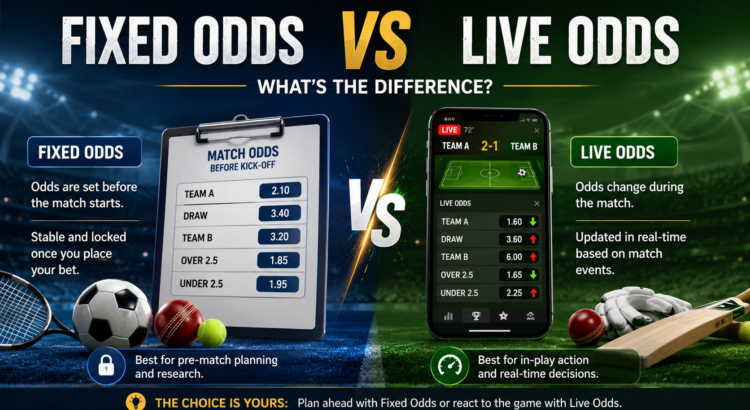
Understanding fixed odds vs live odds is important for anyone who wants to understand how sports betting markets work. Fixed odds provide a price before or during an event that is locked in once a bet is accepted, while live odds change as the match develops.

What Are Fixed Odds?

Fixed odds are betting prices that are agreed when a wager is accepted. Once the bet is placed, the odds attached to that bet generally remain unchanged, even if the market moves later.

For example, suppose a football team is offered at decimal odds of 2.00 before kick-off. If a bettor places a $50 wager at those odds and the bet wins, the total return would be $100, including the original stake.

The important point is that later changes do not normally affect the accepted price. This is one of the main features that makes fixed-odds betting straightforward to understand. The potential return is known when the wager is placed. Cambridge Dictionary similarly defines fixed-odds betting as betting where the amount that can be won does not change after the bet is made.

Fixed odds can be available across many sports and markets, including:

  • Match winner
  • Total goals or runs
  • Player performance
  • Handicap markets
  • Tournament winners
  • First-half or first-innings markets

What Are Live Odds?

Live odds, also called in-play odds, are prices offered while a sporting event is already taking place. Unlike fixed odds, they can change repeatedly as new information becomes available.

A football match is a simple example. Before kick-off, both teams may have relatively balanced prices. If one team scores an early goal, its chance of winning may increase in the market. The odds can then change to reflect the new match situation.

The same principle applies to cricket. A team’s live odds can react to runs, wickets, required run rate, overs remaining, partnerships, player performance and other match developments. Cricbet99’s existing live cricket betting coverage also highlights how these factors can cause odds to move during a match.

Because live markets respond to real-time events, the odds can move much faster than pre-match prices.

Fixed Odds vs Live Odds: Key Differences

The biggest difference between fixed odds and live odds is when the bet is placed and how the price behaves afterward.

FeatureFixed OddsLive Odds
Betting timeUsually before the eventDuring the event
Price movementLocked after acceptanceChanges continuously
InformationPre-match informationReal-time match information
Decision-makingBased on preparation and researchBased on current match events
Market speedGenerally more stableOften changes rapidly
AvailabilityDepends on the marketDepends on live market conditions

Fixed odds can suit someone who prefers to make a decision before the match begins. Live odds may appeal to users who want to follow the action and consider new information as it becomes available.

Why Do Fixed Odds Change Before a Match?

The term “fixed” does not mean that the market price can never change. It means that your accepted price is fixed once the wager is placed.

For example, a football team might open at 2.10 and later move to 1.90 because of team news, injuries, weather, lineup announcements, or market activity. A person who placed the bet at 2.10 generally keeps that accepted price.

This distinction is important because many beginners confuse changing market prices with the settlement of an already accepted bet.

Why Do Live Odds Move So Quickly?

Live odds are designed to reflect the changing probability of an outcome. A major event can therefore cause an immediate price adjustment.

In football, a red card, penalty, goal, or serious injury can change the balance of a match.

In cricket, a wicket can have a similar impact. Consider a team chasing 180 runs in a T20 match. If it is 120/2 after 14 overs, the market may view the chase differently than it would at 90/5 after the same number of overs.

Other factors that can influence live cricket odds include:

  • Current score
  • Wickets in hand
  • Required run rate
  • Overs remaining
  • Batter and bowler form
  • Pitch conditions
  • Weather interruptions
  • Match momentum

This is why live betting requires attention to what is happening on the field rather than relying only on pre-match expectations.

Which Is Easier for Beginners?

For beginners, fixed odds can be easier to understand because the decision is made before the event and the accepted price is clear.

Live betting introduces an additional layer of complexity. Odds can change quickly, markets can be suspended around important events, and there may be less time to assess the available information.

That does not automatically make one format better than the other. The more useful approach is to understand how each market works before deciding whether it fits your preferences and level of experience.

For a broader explanation of sports betting odds, readers can also refer to established betting terminology resources and educational guides. The UNODC notes that fixed-odds betting allows the potential winning amount to be known in advance, while live betting involves wagering in real time during a competition.

How to Read Odds More Effectively

Regardless of whether the market is fixed or live, understanding the odds is essential.

With decimal odds, the basic calculation is:

Total Return = Stake × Decimal Odds

For example, a $20 stake at 2.50 odds would produce a potential total return of $50 if the prediction is successful.

However, odds should not be treated as a guarantee. A shorter price generally represents a market assessment of a higher likelihood, while a higher price indicates a lower implied probability. The actual result can still go either way.

Comparing markets, checking team news and understanding the factors behind price movements can provide useful context, but no betting method can remove uncertainty from sport.

Fixed Odds or Live Odds: Which Should You Choose?

There is no universal answer. The better option depends on how someone prefers to approach sports betting.

Fixed odds may be more suitable for people who like to research a match beforehand and make a decision without reacting to every development.

Live odds may be more suitable for those who closely follow matches and want to consider real-time information before making a decision.

The key difference is not simply the potential return. It is the amount and type of information available when the decision is made.

Responsible Betting Matters

Live betting can be particularly fast-paced, which can make it easier to make decisions without enough consideration. Setting a budget before betting, avoiding the temptation to chase losses, and treating betting as entertainment rather than a guaranteed source of income are important principles.

Users should also check whether sports betting is legally permitted in their location and use only properly authorised services where applicable. Gambling rules can differ significantly between countries and regions.

Frequently Asked Questions

Are fixed odds and live odds the same?

No. Fixed odds are locked once an accepted wager is placed, while live odds can change during an event as match conditions develop.

Can fixed odds change after I place a bet?

The market price can change after your wager, but the accepted price on a standard fixed-odds bet generally remains the price used for settlement.

Why do live odds change?

Live odds respond to events happening during a match, such as goals, wickets, injuries, red cards, score changes, and other factors that can alter the expected outcome.

Are live odds better than fixed odds?

Neither is automatically better. Fixed odds provide a more stable pre-match decision, while live odds allow decisions to be made using information from the match itself.

Can live odds change after every event?

Yes. Depending on the sport and market, prices can change after important events and sometimes very quickly. Markets may also be temporarily suspended around significant events.

What should beginners learn first?

Beginners should understand decimal odds, potential returns, basic sports markets, and the difference between pre-match and in-play betting before considering more complex markets.

Final Thought

The difference between fixed odds and live odds mainly comes down to timing and price movement. Fixed odds provide an agreed price when a bet is accepted, while live odds respond to what is happening during the sporting event.

For football, cricket, tennis, basketball, and other sports, understanding this distinction can make betting terminology much easier to follow. Rather than focusing only on changing numbers, it is useful to understand why those numbers move and what information is influencing the market.

Whether considering fixed or live markets, informed decision-making and responsible betting should always remain more important than chasing a particular price.

How sports betting odds react to breaking sports news

How Odds React to Breaking Sports News

Sports move quickly, but betting markets can move even faster. A player injury, unexpected lineup change, coaching decision, weather update, or late transfer can change the way a match is viewed within minutes. For anyone following sports betting odds, understanding this reaction is just as important as knowing the teams involved.

Odds are not fixed numbers. They reflect the market’s current assessment of an event, and that assessment can change whenever meaningful information becomes available. Breaking sports news is therefore one of the most important factors behind sudden odds movement.

Why Breaking News Can Move Odds So Quickly

Before a match begins, bookmakers build their prices using a combination of statistics, team strength, player form, injuries, historical performance, venue conditions and other relevant information. Once new information appears, those calculations may need to change.

Consider a simple example. A football team may open as a strong favourite because its starting striker is expected to play. If reliable news later confirms that the striker is unavailable, the team’s expected attacking strength changes. The market may then shorten the opponent’s odds while increasing the favourite’s price.

The same principle applies across cricket, football, basketball, tennis and other sports.

Research and market analysis consistently show that injuries, lineup news and changing market demand can contribute to significant line movement.

The Biggest Types of Breaking News That Affect Odds

Not every news story has the same impact. The reaction generally depends on how much the information changes the expected outcome.

1. Player Injuries

Injuries are among the most obvious reasons for sudden odds movement.

The absence of a star batter in cricket, a starting quarterback in American football, or a leading scorer in basketball can materially change a team’s expected performance.

The timing also matters. News released several days before a game may be gradually absorbed by the market. A confirmed injury shortly before kickoff or tip-off can produce a much sharper adjustment.

2. Confirmed Lineups

Rumours may create small movements, but confirmed team news often has a stronger effect.

For example, if a cricket team unexpectedly rests its leading fast bowler, the opposition’s chances may be reassessed. In football, a surprise formation or missing midfielder can change expectations about possession, goals and defensive stability.

This is why checking official team announcements is often more useful than relying only on social media speculation.

3. Transfers and Coaching Changes

Long-term markets can react to major developments even when there is no immediate match.

A high-profile transfer can affect championship, tournament or team futures. A new manager may also change expectations because tactical style, squad selection and team performance could develop differently.

Recent sports betting coverage has demonstrated how major player moves can cause noticeable changes in futures markets.

4. Weather and Venue News

Weather can be particularly important in cricket and outdoor sports.

Rain, strong wind, extreme heat or a change in playing conditions can influence scoring patterns and tactical decisions. In cricket, for example, a forecast of rain may also introduce the possibility of a shortened match and a different result calculation.

Venue changes can have a similar effect when home advantage or playing conditions are important.

5. Unexpected Match Developments

Breaking news does not stop when the game starts.

During live betting, every major event can affect available prices. A wicket, red card, injury, goal, change in required run rate or momentum swing can cause odds to update almost immediately.

The UK Gambling Commission notes that in-play prices are continuously amended according to available information and operator liabilities, with real-time data playing an important role in updating markets.

Why Some News Creates a Bigger Odds Reaction

The size of an odds movement depends on the importance and reliability of the information.

A minor squad update may barely affect the market. However, confirmation that a key player is unavailable can cause a much larger adjustment.

There is also a difference between a rumour and verified information.

Suppose social media reports that a star player may miss a match. Some market participants might react immediately, but bookmakers may wait for stronger confirmation. Once the information becomes official, the market can move more decisively.

This is one reason experienced sports bettors pay attention to the source of breaking news, not just the headline.

How to Read an Odds Movement

An odds movement should not automatically be interpreted as a prediction that something will happen.

If a team’s decimal odds move from 2.00 to 1.70, the market is generally pricing that outcome more favourably than before. However, shorter odds do not guarantee the result.

Similarly, if odds move from 1.60 to 2.10, it indicates that the market’s assessment has changed, but it does not mean the original favourite can no longer win.

The important question is why the odds moved.

Was there an injury? Was the lineup confirmed? Did the weather change? Did the market receive new information? Or was there simply a large amount of betting activity?

Understanding the reason behind the movement provides much more context than looking at the number alone.

Breaking News and Cricket Betting

Cricket is particularly interesting because one piece of news can affect several markets simultaneously.

A late injury to a key bowler may influence:

  • Match-winner odds
  • Team totals
  • Player performance markets
  • Run-related markets
  • Live betting expectations

Similarly, a change in the playing XI can alter the balance between batting and bowling.

Readers looking to understand the fundamentals behind changing cricket markets can explore this guide to cricket betting odds, which explains how factors such as team strength, player form, pitch conditions and match situations influence prices.

The key is to treat odds movement as information about changing market expectations rather than as a guaranteed signal.

Should You React Immediately to Breaking News?

Speed can matter, but rushing can also create mistakes.

Breaking news often creates an emotional response. A bettor may see a headline and immediately assume the market has found an obvious opportunity. By the time they react, however, the odds may already have adjusted.

A better approach is to verify the information, understand its likely impact and compare the current market with the original price.

It is also worth remembering that betting involves financial risk. Responsible gambling means setting limits, understanding the rules and avoiding decisions based on pressure or the desire to recover previous losses.

How to Stay Ahead of Odds Movement

A simple information routine can make sports analysis more organised.

First, follow official team and league announcements. Next, monitor reputable sports news sources for injuries, suspensions and lineup updates. Then compare how the market changes after significant information appears.

For cricket fans, keeping track of the playing XI, toss, pitch report, weather and current match situation can be especially useful.

The goal should not be to react to every headline. Instead, focus on news that can realistically change the probability of an outcome.

Frequently Asked Questions

Why do sports betting odds change after breaking news?

Odds change because new information can alter the expected probability of an outcome. Injuries, lineups, weather, transfers and other developments can all influence market prices.

Which breaking news has the biggest impact on odds?

Major player injuries, confirmed lineup changes, suspensions and significant tactical or team developments can have a substantial impact, especially when they involve important players.

Do odds always move in the same direction as public opinion?

Not necessarily. Market movement can reflect different factors, including new information, betting activity, risk management and changes in the underlying probability.

Are shorter odds a guarantee of winning?

No. Shorter odds indicate that an outcome is being priced as more likely, but no betting price guarantees a result.

Can breaking news affect live betting odds?

Yes. Live markets respond to real-time developments such as scores, wickets, goals, injuries and other important events. Prices can change very quickly during an event.

What is the best way to verify breaking sports news?

Official team, league and tournament announcements are generally preferable to unverified social media posts. Reputable sports journalism can also help confirm important developments.

Final Thought

Breaking sports news has become one of the biggest drivers of movement in modern betting markets. A confirmed injury, unexpected lineup, weather update or major transfer can change market expectations within minutes.

For followers of sports betting odds, the real skill is not simply noticing that a price has moved. It is understanding why it moved and whether the underlying information genuinely changes the outlook for the event.

By combining reliable sports news with careful market analysis, bettors can develop a clearer understanding of how prices respond to information. Most importantly, odds should always be viewed as probabilities rather than guarantees, and any betting activity should be approached responsibly and within personal limits.

Market suspensions during live sports cricket

Understanding Market Suspensions During Live Sports

Live sports are unpredictable by nature. A wicket can change the direction of a cricket match in seconds, while a red card, injury, penalty, or sudden weather interruption can completely alter the situation in another sport. For people following live sports markets, these moments can also cause certain betting markets to become temporarily unavailable.

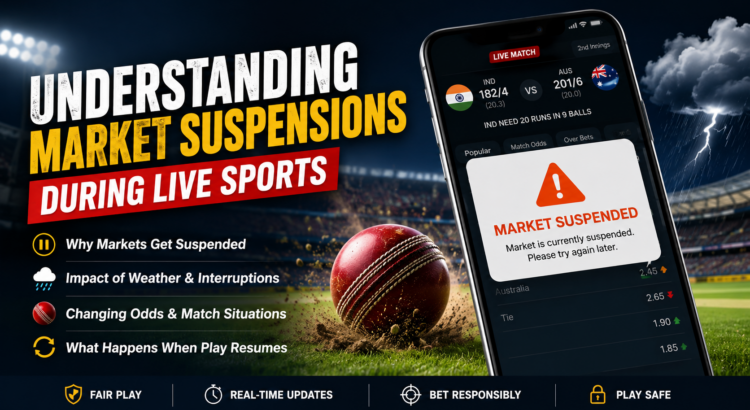
This is known as a market suspension.

A suspended market does not necessarily mean that an event has been cancelled or that a particular market has closed permanently. In many cases, it is a temporary pause while the latest match information is processed and updated. Understanding why this happens can make the live sports experience much easier to follow.

What Is a Market Suspension?

A market suspension occurs when a betting operator temporarily stops accepting new bets on a particular market.

For example, during a cricket match, a market may be suspended immediately after a wicket falls. The same can happen when a batter hits a boundary, a review is underway, or play is interrupted because of rain.

The main reason is simple: the probability of different outcomes can change very quickly during live action. The prices shown before a major event may no longer accurately reflect the current situation.

Instead of continuing to accept bets using outdated information, the market can be paused until new prices are calculated.

This is particularly relevant to live sports betting, where information changes much faster than it does before a match begins.

Why Do Cricket Markets Get Suspended?

Cricket provides several situations where temporary suspensions are common.

A wicket is one of the clearest examples. If a key batter is dismissed, the expected score, match momentum, and chances of winning can change immediately. A market may therefore be paused while the system updates the available prices.

Other common situations include:

  • A wicket or run-out
  • A boundary or six
  • A review by the third umpire
  • The end of an over
  • A change of innings
  • An injury or unexpected delay
  • Rain or poor weather
  • Changes to the number of overs
  • A match interruption or possible abandonment

Weather is especially important in cricket. According to the International Cricket Council’s playing conditions, umpires can suspend play when ground, weather, light, or other circumstances become dangerous or unreasonable.

When play stops, the betting market may also require an adjustment because the circumstances of the match have changed.

How Does a Suspension Affect Live Markets?

A suspension generally means that new bets cannot be placed on the affected market for a period of time.

The existing market may return once the situation becomes clearer. When it does, the available prices can be different from those shown before the suspension.

For instance, imagine a team is chasing 180 runs and needs 30 runs from 18 balls. If its main batter is suddenly dismissed, the situation changes instantly. Once the system has processed the wicket and updated the relevant information, the market may reopen with different prices.

This is why repeatedly refreshing a suspended market usually does not provide an advantage. The pause is part of the process of updating the market rather than simply a website loading problem.

What Happens During a Rain Interruption?

Rain creates a more complicated situation because it can affect the structure of the match itself.

If overs are lost, the target or number of available overs may change. In limited-overs cricket, the Duckworth-Lewis-Stern method can be used to calculate a revised target when weather interrupts play. The ICC explains that DLS is designed to adjust targets fairly when playing time is lost.

This can have a major effect on live markets.

A team that appeared comfortably ahead before the interruption may have a completely different situation after play resumes. Until officials confirm what will happen, markets can remain suspended.

The suspension therefore gives the operator time to work with the latest official information instead of relying on assumptions.

Does a Suspended Market Mean Something Is Wrong?

Not necessarily.

A market suspension can be a normal part of live sports operations. The exact reason and duration can vary between sports, events, markets, and operators.

In cricket, the pause may last only briefly after a routine event. A longer suspension can occur when there is uncertainty about whether play will continue, such as during severe weather or an extended injury delay.

It is also important to remember that different operators may handle individual markets differently. Some markets may remain available while others are temporarily suspended.

Market Suspension vs Match Suspension

These two terms sound similar but refer to different things.

A match suspension concerns the sporting event itself. For example, cricket play can be stopped because of rain, bad light, unsafe conditions, or another interruption.

A market suspension concerns the availability of a betting market.

The two can happen together, but they are not identical.

For example, a cricket match may continue normally while one specific market is suspended after a wicket. Conversely, a match may be suspended because of rain, causing several related markets to become unavailable at the same time.

Understanding this difference helps explain why one market can disappear while other information about the match remains visible.

Why Understanding Suspensions Matters

For anyone researching live sports markets, understanding suspensions is more useful than simply reacting whenever a market disappears.

A suspension tells you that the information behind a market may be changing. Instead of assuming that something has gone wrong, it is better to check the match situation and wait for official information.

This is particularly important during fast-moving cricket matches. A single delivery can change the match dramatically, and the market needs to reflect those changes.

Keeping up with reliable match information, official playing conditions, and broader cricket betting insights can help readers understand why live markets behave differently at different stages of a game.

The same principle applies across football, tennis, basketball, baseball, and other live sports. A major event can create uncertainty, and a temporary pause gives the market time to catch up with what has happened on the field or court.

How to Follow Suspensions Responsibly

Live sports can be exciting, but it is important not to treat market movement as a guarantee of a particular result.

Odds and markets represent changing probabilities rather than certainty. A suspension should not be viewed as a signal that one team or player is suddenly guaranteed to win.

Readers should also understand the laws and regulations that apply in their location. Gambling rules differ significantly between countries. For example, Singapore has specific restrictions around gambling activities and licensing under its Gambling Control Act.

Following official regulations and using only lawful, authorised services where applicable is an important part of responsible participation.

FAQs About Market Suspensions During Live Sports

Why are cricket betting markets suspended during a match?

Markets can be suspended when an important event changes the current situation, such as a wicket, review, boundary, injury, innings change, or weather interruption. The pause allows the market information and prices to be updated.

How long does a market suspension usually last?

There is no fixed duration. A routine suspension may be brief, while interruptions involving weather, injuries, reviews, or uncertainty about the match can take considerably longer.

Can a market reopen after being suspended?

Yes. A temporarily suspended market can reopen when the relevant information has been confirmed and the operator has updated the market. However, some markets may remain closed depending on the circumstances.

Is a suspended market the same as a cancelled match?

No. A suspended market only means that betting activity on a particular market has been paused. A match can continue, be temporarily interrupted, or eventually be abandoned independently of the market status.

Why do odds change after a market suspension?

Odds can change because the situation on the field has changed. A wicket, goal, injury, score update, or weather interruption can alter the estimated probability of different outcomes.

Does rain always cause cricket markets to be suspended?

Not necessarily. The response depends on the circumstances and the specific market. However, significant weather interruptions can lead to markets being temporarily suspended while officials determine how the match will proceed.

Final Thought

Market suspensions are a normal part of the fast-moving nature of live sports. In cricket especially, a single ball can change the balance of a match, making accurate and up-to-date information essential.

Rather than seeing a suspended market as a technical problem, it is more useful to understand it as a pause while new information is assessed. Whether the trigger is a wicket, review, injury, rain interruption, or change in playing conditions, the underlying purpose is to prevent a market from operating on outdated information.

For sports followers, understanding these pauses can make live match coverage easier to interpret and provide a clearer picture of how rapidly changing events affect live markets.

Live betting markets updating during a sports event

How Betting Markets Are Updated During Live Events

Live sports have changed the way people follow betting markets. Instead of checking odds before a match and waiting for the final result, users can now watch markets move while the action is happening. A goal, wicket, injury, red card, timeout, or even a change in the remaining time can cause odds to shift within seconds.

But what actually happens behind the scenes?

Live betting markets are powered by a combination of real-time sports data, mathematical models, automated trading systems, market risk management, and fast communication networks. Understanding this process makes it easier to see why live odds change so quickly and why some markets temporarily disappear during important moments.

What Are Live Betting Markets?

Live betting, also known as in-play betting, refers to markets that remain available after a sporting event has started. Unlike pre-match markets, live markets respond to the current state of the event.

For example, a cricket match may begin with one team priced as the favorite. If that team loses two early wickets, the probability of winning changes. The sportsbook can then recalculate its prices based on the new match situation.

The same principle applies across sports. In football, a goal can immediately change match-winner and total-goals markets. In tennis, a break of serve can influence the price of the next game, set, or match. In basketball, the score, possession, fouls, and time remaining can all affect available markets.

The UK’s Gambling Commission describes in-play betting as betting while an event is actually taking place and highlights the importance of timely information because live broadcasts can have latency.

1. Real-Time Data Is the Starting Point

The first step in updating a live market is collecting accurate information from the event.

Sportsbooks can receive structured data feeds containing information such as:

  • Current score
  • Time remaining
  • Wickets and overs in cricket
  • Possession and game state
  • Player substitutions
  • Cards and penalties
  • Player statistics
  • Injuries or retirements
  • Previous match events

For major competitions, professional data providers distribute detailed event information at high speed. The ICC, for example, announced Stats Perform as its official data partner for major ICC events, including the distribution of official data to licensed betting operators.

This data gives pricing systems the information required to update probabilities as the match develops.

2. Pricing Models Recalculate Probabilities

Once new information arrives, a sportsbook’s pricing system evaluates what that information means for each outcome.

The basic idea is straightforward: betting odds represent a price based on the estimated probability of an outcome.

Imagine a cricket team starts a T20 match as the favorite. After ten overs, the team may have lost several wickets and scored fewer runs than expected. The live model now has a different picture of the match.

It can consider factors such as the current score, wickets remaining, overs left, batting strength, bowling resources, historical performance, and pre-match expectations.

The system then estimates the probability of different outcomes and converts those probabilities into betting prices.

This process happens repeatedly as new information arrives.

3. Why Markets Sometimes Move Almost Instantly

Not every event has the same effect on betting markets.

A normal delivery in cricket may produce only a small adjustment, while a wicket can create a much larger change. Similarly, a goal in football or a red card can immediately alter the expected outcome.

For example, consider a T20 match where a team needs 60 runs from 30 balls with seven wickets remaining. If the batter hits a six, the overall situation changes only slightly. If the team’s main batter is dismissed on the next ball, the expected probability can change much more significantly.

That is why live markets can appear to jump from one price to another rather than moving smoothly.

4. Market Suspension Is Part of the Process

One of the most noticeable features of live betting is market suspension.

You may see a market disappear for a few seconds immediately after a major event. This does not necessarily indicate a technical problem. It can happen because the sportsbook needs time to process new information and recalculate its prices.

A market may be suspended around:

  • A wicket in cricket
  • A goal in football
  • A penalty decision
  • A red card
  • A major injury
  • A review or official decision
  • A change in possession
  • The end of an over or period of play

Once the new state of the event has been processed, the market can reopen with updated prices.

This is especially important because accepting bets while an event is changing rapidly could result in prices that no longer accurately represent the current situation.

5. Time Is One of the Most Important Variables

Time remaining has a major influence on live markets.

A one-run lead in cricket with 18 overs remaining is very different from a one-run lead with only two overs left. Similarly, a football team leading 1-0 after 10 minutes faces a very different situation from a team leading 1-0 in the 88th minute.

As the clock moves forward, the number of opportunities remaining changes.

This means odds can move even when no major event has occurred. Simply allowing time to pass can alter the probability of different outcomes.

In cricket, this can be particularly visible in markets related to totals, innings outcomes, and match winners.

6. Betting Markets Can React to More Than the Score

The score is important, but it is not the only factor used to evaluate a live market.

A pricing system may also consider the quality of the players currently involved, the remaining resources, historical performance, match conditions, and other available data.

In cricket, for example, a sportsbook may need to account for:

  • Required run rate
  • Wickets in hand
  • Overs remaining
  • Batting order
  • Bowling options
  • Recent scoring patterns
  • Powerplay or death-over conditions
  • Individual player performance

This helps explain why two teams with the same score can sometimes have very different live prices depending on the circumstances surrounding that score.

7. Live Data and Broadcasts Are Not Always Synchronized

Another important factor is latency.

A person watching a match through television or an online stream may see an event slightly after it has happened in the actual venue. The betting operator’s data feed can potentially receive information faster than the viewer’s broadcast.

This creates an important timing difference.

The UK Gambling Commission specifically requires information about the potential delay of live broadcasts to be made available for in-play betting, noting that customers may not always have the latest information available.

For this reason, seeing something happen on screen does not necessarily mean the same information has not already reached the betting market.

8. Why Different Markets Move Differently

A live event can affect several markets at once, but not every market reacts in exactly the same way.

Suppose a cricket team loses its opening batter.

The match-winner market may move because the team’s expected performance has changed. A total-runs market may also change. Player-specific markets involving the dismissed batter may close or settle according to their rules, while other player markets may remain active.

This creates a constantly changing network of related markets.

Sportsbooks therefore need pricing systems capable of updating multiple markets while maintaining consistency between them.

9. Technology Helps Manage Risk

Live betting creates more opportunities for price changes, which also means sportsbooks need sophisticated risk-management systems.

Automated systems can monitor prices, incoming bets, market exposure, and changing match conditions. If a significant event occurs, markets can be suspended while the system recalculates.

The objective is not simply to make odds change quickly. The system also needs to keep prices consistent with the latest available information and manage the operator’s financial exposure.

This is one reason modern live betting is much more technology-driven than traditional pre-match betting.

What This Means for Sports Fans

For anyone following live sports, understanding how markets are updated can make the betting screen easier to interpret.

A sudden odds movement does not automatically mean that something mysterious has happened. It may simply reflect a new wicket, a goal, an injury, changing time pressure, or updated statistical information.

For those following cricket specifically, platforms offering live cricket betting can provide a combination of live markets, updated odds, and match information while the game is underway. The key is to understand that live prices are constantly reacting to changing circumstances rather than remaining fixed throughout the event.

FAQs

Why do betting odds change during live events?

Live odds change because the probability of different outcomes changes as the event develops. Score, time remaining, player performance, injuries, and other match events can all influence the pricing model.

Why are live betting markets suspended?

Markets may be suspended during major events so the sportsbook can process new information and calculate updated prices before accepting further bets.

Does the score alone determine live odds?

No. The score is important, but pricing systems can also consider time remaining, player strength, match statistics, game state, and other relevant information.

Why can live odds change before I see an event on TV?

Live broadcasts can have a delay compared with the action at the venue. Official or specialist data feeds can reach operators faster than a television or streaming broadcast.

Do live odds stay the same throughout a match?

No. Live odds can change repeatedly as new information becomes available. Even the passage of time can influence prices when the remaining opportunities in a match decrease.

Final Thought

Live betting markets are essentially a real-time reflection of a sporting event. Behind every changing price is a combination of live data, probability models, automated systems, and risk management.

From a cricket wicket to a football goal, every meaningful event can change the mathematical picture of a match. That is why live markets can move so quickly and why temporary suspensions are common during important moments.

For sports fans, understanding this technology provides a clearer view of what is happening behind the odds. It also reinforces an important point: live betting moves quickly, and the information available to a viewer may not always be identical to the information reaching the market.