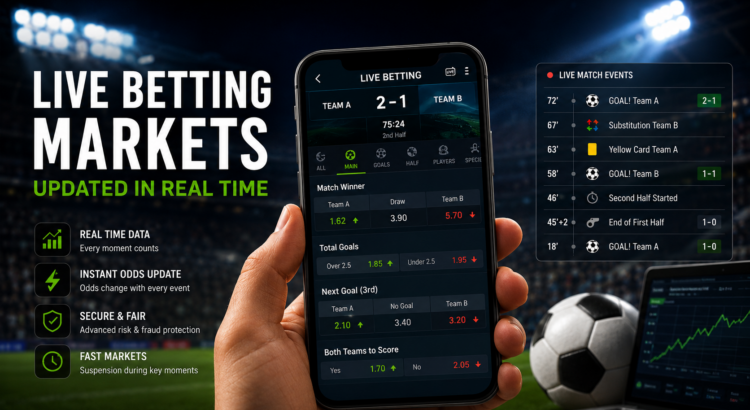
Live sports have changed the way people follow betting markets. Instead of checking odds before a match and waiting for the final result, users can now watch markets move while the action is happening. A goal, wicket, injury, red card, timeout, or even a change in the remaining time can cause odds to shift within seconds.
But what actually happens behind the scenes?
Live betting markets are powered by a combination of real-time sports data, mathematical models, automated trading systems, market risk management, and fast communication networks. Understanding this process makes it easier to see why live odds change so quickly and why some markets temporarily disappear during important moments.
What Are Live Betting Markets?
Live betting, also known as in-play betting, refers to markets that remain available after a sporting event has started. Unlike pre-match markets, live markets respond to the current state of the event.
For example, a cricket match may begin with one team priced as the favorite. If that team loses two early wickets, the probability of winning changes. The sportsbook can then recalculate its prices based on the new match situation.
The same principle applies across sports. In football, a goal can immediately change match-winner and total-goals markets. In tennis, a break of serve can influence the price of the next game, set, or match. In basketball, the score, possession, fouls, and time remaining can all affect available markets.
The UK’s Gambling Commission describes in-play betting as betting while an event is actually taking place and highlights the importance of timely information because live broadcasts can have latency.
1. Real-Time Data Is the Starting Point
The first step in updating a live market is collecting accurate information from the event.
Sportsbooks can receive structured data feeds containing information such as:
- Current score
- Time remaining
- Wickets and overs in cricket
- Possession and game state
- Player substitutions
- Cards and penalties
- Player statistics
- Injuries or retirements
- Previous match events
For major competitions, professional data providers distribute detailed event information at high speed. The ICC, for example, announced Stats Perform as its official data partner for major ICC events, including the distribution of official data to licensed betting operators.
This data gives pricing systems the information required to update probabilities as the match develops.
2. Pricing Models Recalculate Probabilities
Once new information arrives, a sportsbook’s pricing system evaluates what that information means for each outcome.
The basic idea is straightforward: betting odds represent a price based on the estimated probability of an outcome.
Imagine a cricket team starts a T20 match as the favorite. After ten overs, the team may have lost several wickets and scored fewer runs than expected. The live model now has a different picture of the match.
It can consider factors such as the current score, wickets remaining, overs left, batting strength, bowling resources, historical performance, and pre-match expectations.
The system then estimates the probability of different outcomes and converts those probabilities into betting prices.
This process happens repeatedly as new information arrives.
3. Why Markets Sometimes Move Almost Instantly
Not every event has the same effect on betting markets.
A normal delivery in cricket may produce only a small adjustment, while a wicket can create a much larger change. Similarly, a goal in football or a red card can immediately alter the expected outcome.
For example, consider a T20 match where a team needs 60 runs from 30 balls with seven wickets remaining. If the batter hits a six, the overall situation changes only slightly. If the team’s main batter is dismissed on the next ball, the expected probability can change much more significantly.
That is why live markets can appear to jump from one price to another rather than moving smoothly.
4. Market Suspension Is Part of the Process
One of the most noticeable features of live betting is market suspension.
You may see a market disappear for a few seconds immediately after a major event. This does not necessarily indicate a technical problem. It can happen because the sportsbook needs time to process new information and recalculate its prices.
A market may be suspended around:
- A wicket in cricket
- A goal in football
- A penalty decision
- A red card
- A major injury
- A review or official decision
- A change in possession
- The end of an over or period of play
Once the new state of the event has been processed, the market can reopen with updated prices.
This is especially important because accepting bets while an event is changing rapidly could result in prices that no longer accurately represent the current situation.
5. Time Is One of the Most Important Variables
Time remaining has a major influence on live markets.
A one-run lead in cricket with 18 overs remaining is very different from a one-run lead with only two overs left. Similarly, a football team leading 1-0 after 10 minutes faces a very different situation from a team leading 1-0 in the 88th minute.
As the clock moves forward, the number of opportunities remaining changes.
This means odds can move even when no major event has occurred. Simply allowing time to pass can alter the probability of different outcomes.
In cricket, this can be particularly visible in markets related to totals, innings outcomes, and match winners.
6. Betting Markets Can React to More Than the Score
The score is important, but it is not the only factor used to evaluate a live market.
A pricing system may also consider the quality of the players currently involved, the remaining resources, historical performance, match conditions, and other available data.
In cricket, for example, a sportsbook may need to account for:
- Required run rate
- Wickets in hand
- Overs remaining
- Batting order
- Bowling options
- Recent scoring patterns
- Powerplay or death-over conditions
- Individual player performance
This helps explain why two teams with the same score can sometimes have very different live prices depending on the circumstances surrounding that score.
7. Live Data and Broadcasts Are Not Always Synchronized
Another important factor is latency.
A person watching a match through television or an online stream may see an event slightly after it has happened in the actual venue. The betting operator’s data feed can potentially receive information faster than the viewer’s broadcast.
This creates an important timing difference.
The UK Gambling Commission specifically requires information about the potential delay of live broadcasts to be made available for in-play betting, noting that customers may not always have the latest information available.
For this reason, seeing something happen on screen does not necessarily mean the same information has not already reached the betting market.
8. Why Different Markets Move Differently
A live event can affect several markets at once, but not every market reacts in exactly the same way.
Suppose a cricket team loses its opening batter.
The match-winner market may move because the team’s expected performance has changed. A total-runs market may also change. Player-specific markets involving the dismissed batter may close or settle according to their rules, while other player markets may remain active.
This creates a constantly changing network of related markets.
Sportsbooks therefore need pricing systems capable of updating multiple markets while maintaining consistency between them.
9. Technology Helps Manage Risk
Live betting creates more opportunities for price changes, which also means sportsbooks need sophisticated risk-management systems.
Automated systems can monitor prices, incoming bets, market exposure, and changing match conditions. If a significant event occurs, markets can be suspended while the system recalculates.
The objective is not simply to make odds change quickly. The system also needs to keep prices consistent with the latest available information and manage the operator’s financial exposure.
This is one reason modern live betting is much more technology-driven than traditional pre-match betting.
What This Means for Sports Fans
For anyone following live sports, understanding how markets are updated can make the betting screen easier to interpret.
A sudden odds movement does not automatically mean that something mysterious has happened. It may simply reflect a new wicket, a goal, an injury, changing time pressure, or updated statistical information.
For those following cricket specifically, platforms offering live cricket betting can provide a combination of live markets, updated odds, and match information while the game is underway. The key is to understand that live prices are constantly reacting to changing circumstances rather than remaining fixed throughout the event.
FAQs
Why do betting odds change during live events?
Live odds change because the probability of different outcomes changes as the event develops. Score, time remaining, player performance, injuries, and other match events can all influence the pricing model.
Why are live betting markets suspended?
Markets may be suspended during major events so the sportsbook can process new information and calculate updated prices before accepting further bets.
Does the score alone determine live odds?
No. The score is important, but pricing systems can also consider time remaining, player strength, match statistics, game state, and other relevant information.
Why can live odds change before I see an event on TV?
Live broadcasts can have a delay compared with the action at the venue. Official or specialist data feeds can reach operators faster than a television or streaming broadcast.
Do live odds stay the same throughout a match?
No. Live odds can change repeatedly as new information becomes available. Even the passage of time can influence prices when the remaining opportunities in a match decrease.
Final Thought
Live betting markets are essentially a real-time reflection of a sporting event. Behind every changing price is a combination of live data, probability models, automated systems, and risk management.
From a cricket wicket to a football goal, every meaningful event can change the mathematical picture of a match. That is why live markets can move so quickly and why temporary suspensions are common during important moments.
For sports fans, understanding this technology provides a clearer view of what is happening behind the odds. It also reinforces an important point: live betting moves quickly, and the information available to a viewer may not always be identical to the information reaching the market.