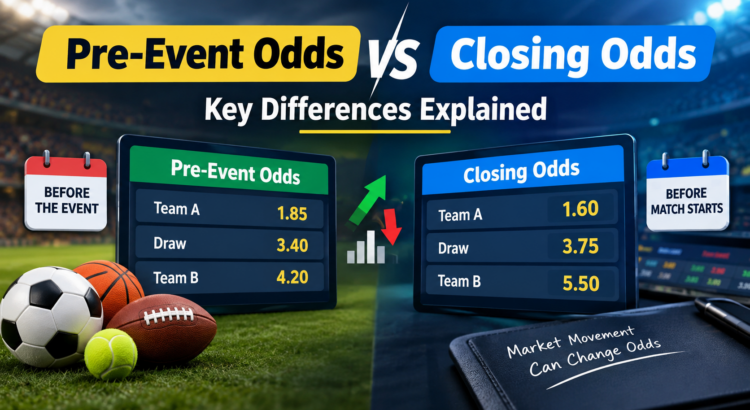
Sports betting markets can change significantly between the moment odds are first published and the start of an event. A team that opens at one price may be available at very different odds shortly before kickoff. For bettors trying to understand how markets work, this movement raises an important question: what is the difference between pre-event odds and closing odds, and why does it matter?
The answer becomes clearer when you look at how information enters a sports market. Team news, injuries, confirmed lineups, weather, public betting activity and professional money can all influence prices before an event begins. The closing odds represent the market price at the end of that process, while pre-event odds describe prices available earlier in the buildup.
Understanding the difference can help readers interpret odds movement without assuming that every price change automatically represents a winning opportunity.
What Are Pre-Event Odds?
Pre-event odds are the prices available before a sporting event starts. They can appear hours or even days before the scheduled start, depending on the sport and market.
At this stage, bookmakers and betting markets are working with the information available at that particular moment. For example, a cricket match may initially be priced using team strength, recent performances, player statistics, venue conditions and historical results.
Suppose a hypothetical cricket match opens with:
- Team A: 1.90
- Team B: 1.90
The market initially views the two sides as relatively evenly matched. However, these prices are not necessarily fixed. As more information becomes available, the market can adjust.
For anyone comparing sports betting odds, the important point is that an early price is simply a snapshot of the market at a particular time.
What Are Closing Odds?
Closing odds are the final available prices immediately before the event begins. They are often used as an important reference point because they incorporate information and market activity that occurred after the initial prices were released.
Imagine Team A’s odds move like this:
Opening price: 1.90
Several hours before the match: 1.80
Just before the start: 1.65
The 1.65 price is the closing figure in this simplified example.
The movement suggests that the market’s assessment of Team A changed during the pre-match period. That could happen because of a confirmed lineup, an injury, changing weather conditions or significant betting activity.
Importantly, closing odds should not be treated as a guaranteed prediction. They are a market price, not a statement that an outcome will definitely happen.
Why Do Odds Move Before an Event?
There is rarely just one reason for a change in odds.
Team news can have an immediate effect. If an important player is ruled out, the market may reassess the team’s chances.
Weather conditions can also matter. This is particularly relevant to cricket, where rain can influence match duration, pitch conditions and strategies.
Confirmed lineups provide information that was unavailable when early prices were released. A strong player returning to the starting XI, for example, can influence market expectations.
Betting activity is another factor. When substantial money enters a market, prices may move as bookmakers and other market participants adjust their positions.
This is why an odds screen can look noticeably different on match day compared with when the market first opened.
Pre-Event Odds vs Closing Odds: A Simple Example
Consider a fictional football match.
A team is initially offered at 2.40. Later, the price moves to 2.10, and finally closes at 1.95.
Someone who took 2.40 obtained a different price from someone who waited until just before the event.
The change does not prove that the first bettor will win. The team could still lose. Instead, it shows that the market moved toward a shorter price after the original bet was placed.
This concept is closely related to closing line value (CLV), which compares the price accepted on a bet with the market’s closing price. A bettor who consistently receives a better price than the eventual close may be demonstrating that their timing or price selection has produced an advantage relative to the later market benchmark.
Why Closing Odds Matter When Studying Betting Performance
Looking only at wins and losses can sometimes give an incomplete picture.
Imagine someone makes ten bets and wins six. That sounds positive at first, but the result alone does not explain whether the prices they received were strong.
Comparing the original odds with closing odds provides another way to evaluate decision-making.
For example, if a bettor repeatedly takes a team at 2.20 and the market later closes around 2.00, those bets consistently beat the closing price. Conversely, regularly taking 2.00 before the market closes at 2.20 indicates the bettor was receiving a less favorable price than the eventual market benchmark.
Research and betting-market analysis commonly use closing prices as a reference, although the closing number should not be interpreted as a perfect measure of true probability. Different operators can have different margins, liquidity and pricing.
Should Bettors Always Wait for Closing Odds?
Not necessarily.
Waiting can provide access to more information, but it can also mean missing an earlier price. If the market moves significantly, the later price may be less attractive.
On the other hand, betting early carries more uncertainty because important information may not yet be available.
There is therefore no universal rule that early or late betting is always better. The more useful approach is to understand why odds move and compare prices within the same market and conditions.
For beginners, this also means avoiding the assumption that a shorter closing price automatically makes the original selection a winner. Sports remain uncertain, and even a well-priced bet can lose.
How to Track Odds Movement
Anyone interested in studying pre-event and closing prices can keep a simple record.
Note the initial price, the time it was available, the price when the bet was placed, and the eventual closing price. Over a larger sample, this can reveal whether decisions were consistently made at prices that later moved in a favorable direction.
It is also important to compare the same market. A match-winner price should not be compared with a handicap or a different settlement condition.
For cricket, additional factors such as the playing XI, toss, pitch report and weather can make timing especially relevant because new information can change market expectations quickly.
Frequently Asked Questions
What is the difference between pre-event odds and closing odds?
Pre-event odds are prices available before a sporting event starts, while closing odds are the final prices available immediately before the event begins.
Why do closing odds change from the opening price?
Odds can move because of injuries, team news, lineups, weather, betting activity and other information entering the market.
Are closing odds always more accurate?
Closing odds incorporate more information and are widely used as a market benchmark, but they are not guaranteed to represent the true probability of an outcome.
What does closing line value mean?
Closing line value compares the odds taken by a bettor with the eventual closing price. It is commonly used to assess whether someone consistently obtained better prices than the market close.
Can a bet lose but still have positive closing line value?
Yes. CLV evaluates the price compared with the closing market, not whether an individual bet won or lost. A selection can lose despite having been placed at a better price than its closing odds.
Final Thought
Pre-event odds and closing odds provide two different snapshots of the same sports market. The first reflects what the market believed with the information available earlier, while the second reflects where prices settled after additional information and betting activity had influenced the market.
For anyone studying sports betting, comparing these two points can offer a clearer understanding of odds movement and market behavior. It should not be viewed as a guarantee of future results, but rather as one useful way to examine how prices change before an event begins.
For readers looking to strengthen their understanding of pricing, probability and market movement, sports betting odds provide a useful starting point before moving into more advanced concepts such as closing line value.