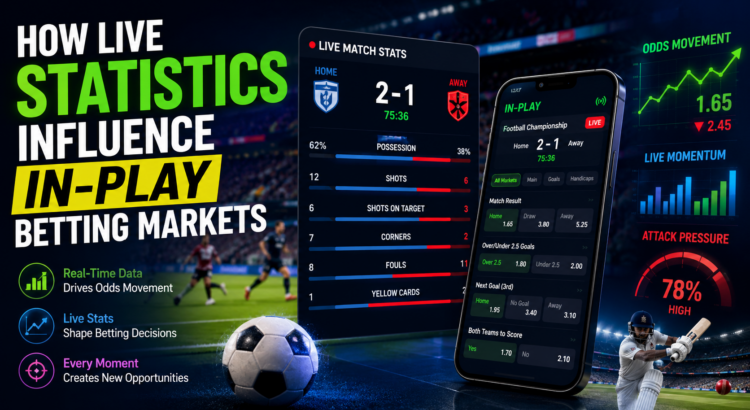
Sports have always been driven by numbers. Scores, possession, wickets, shots, player performance, and time remaining can all help explain what is happening during a match. In modern in-play betting, however, these numbers do more than describe the game. They can directly influence how betting markets react from one moment to the next.
Live statistics provide a constantly changing picture of the match. As new information becomes available, the perceived probability of different outcomes can change, and betting odds may move accordingly. A goal, wicket, red card, scoring streak, or sudden shift in momentum can affect several markets at the same time.
Understanding this relationship can help sports fans better understand why in-play markets move so quickly.
What Are Live Statistics in Sports?
Live statistics are real-time data points collected while a sporting event is in progress. Depending on the sport, these statistics may include:
- Current score
- Time remaining
- Possession
- Shots and shots on target
- Corners
- Fouls and cards
- Runs and wickets
- Overs remaining
- Run rate
- Player performance
- Team momentum
- Injuries and substitutions
The depth and speed of available data can vary between sports and competitions. Professional sports-data systems can deliver real-time match updates, team statistics, player information, and play-by-play events that support live sports experiences.
For in-play markets, the most important point is that the information keeps changing. Unlike pre-match analysis, which is based mainly on historical information and predictions, live markets respond to what is actually happening on the field.
How Live Statistics Affect In-Play Odds
In-play odds are designed to reflect changing match conditions. Before a match starts, bookmakers and markets use information such as team form, player availability, previous results, and historical performance.
Once the game begins, live statistics become increasingly important.
Imagine a football team entering a match as the favourite. After 60 minutes, the score is still 0-0, but the underdog has created more chances and has several shots on target. Even without a goal, the live statistics may suggest that the match is developing differently from the original expectation.
Similarly, in cricket, a team chasing a target may appear comfortable based on the score alone. However, live statistics such as wickets in hand, required run rate, overs remaining, and the performance of current batters can provide a more complete picture.
This is why live odds can change even when the scoreboard itself has not changed dramatically.
The Importance of Major Match Events
Some events create immediate changes in multiple betting markets.
A football goal can affect the match winner, total goals, next-goal, correct-score, and other available markets. A red card may also have a significant impact because it changes the number of players available to one team.
In cricket, a wicket can quickly change expectations about a team’s ability to score or successfully complete a chase. A boundary may improve the required run-rate situation, while consecutive dot balls can increase pressure.
Live data feeds are built to capture these events quickly and accurately because speed is particularly important when markets are reacting to events in progress. Real-time sports-data services can provide match events and statistics as the action unfolds.
Why Momentum Can Influence Live Markets
Momentum is one of the most discussed concepts in live sports.
Although momentum is not always represented by a single statistic, it can often be reflected through several live data points. For example, a football team may have sustained possession, multiple attacking moves, and repeated shots in a short period.
In basketball, a scoring run can change the flow of a game. In cricket, a strong partnership or a series of quick wickets can completely alter the match situation.
Markets may respond when multiple live indicators point in the same direction. However, sports remain unpredictable, and a period of dominance does not guarantee the final result.
This distinction is important for anyone following live markets. Statistics can provide useful context, but they cannot remove uncertainty from sport.
Live Statistics and Player-Based Markets
Live statistics can also influence player markets.
A batter who has already settled at the crease may be viewed differently from a player who has just entered under pressure. In football, a player creating repeated chances or taking several shots may attract attention in player-performance markets.
The same principle applies across many sports. Current performance can change the perception of what may happen next.
However, live statistics should be viewed alongside the wider match context. A player may have strong individual numbers but still be affected by tactics, opposition adjustments, fatigue, or changing conditions.
For this reason, experienced sports followers often look at more than one number before forming an opinion.
Why Some In-Play Markets Are Suspended
People following live betting may notice that markets sometimes become temporarily unavailable.
This can happen around important moments when new information needs to be processed. For example, a market may be suspended during a key event or while an outcome is being confirmed.
Live-data systems also include procedures for interruptions and recovery. Documentation for live betting data feeds notes that markets may need to be suspended when reliable live information is temporarily unavailable.
Market suspension is therefore an important part of handling rapidly changing information.
The Difference Between Watching the Match and Reading Statistics
Live statistics can be extremely useful, but numbers do not always tell the complete story.
For example, a football team may have more possession but create fewer dangerous opportunities. A cricket team may have a strong run rate but be losing wickets at a concerning pace.
Watching the match, when possible, can provide additional context that raw numbers may not immediately show.
The strongest understanding often comes from combining:
- The live score
- Match statistics
- Time remaining
- Player performance
- Team tactics
- Current match conditions
This approach provides a broader picture instead of focusing on one statistic alone.
Understanding Live Markets More Clearly
For sports fans interested in understanding how in-play betting works, it is useful to start with the basics rather than reacting to every movement in the odds.
Knowing why odds change can make the overall experience easier to follow. A live market is constantly responding to new information, and that information may include both major events and smaller statistical changes.
Users looking for information about sports markets and online betting access can also find relevant resources through a Cricbet99 ID Provider, where readers can navigate to the platform’s broader sports and betting-related content.
The key is to remember that live statistics provide information, not certainty. Even the strongest statistical position can change within a few minutes.
How to Use Live Statistics Responsibly
The speed of in-play markets can sometimes encourage emotional decisions. When odds move quickly, it may feel necessary to react immediately.
A better approach is to take a moment to understand why the market may have changed.
Ask questions such as:
- What has actually changed in the match?
- Is the movement caused by a major event?
- Do the live statistics support the change?
- How much time remains?
- Could the current situation change again?
It is also important to set personal limits and avoid treating sports betting as guaranteed income. Statistics and analysis can improve understanding, but no data point can guarantee a particular result.
FAQs
How do live statistics change in-play betting markets?
Live statistics provide updated information about the match, such as scores, player performance, possession, wickets, and time remaining. These changes can affect how markets assess the probability of different outcomes.
Why do betting odds change even when no goal or wicket occurs?
Odds can move because several smaller statistics may change the overall match picture. Possession, attacking pressure, shots, run rate, or time remaining can all influence market expectations.
Are live statistics enough to predict the result of a match?
No. Statistics provide useful information, but sports remain unpredictable. Injuries, tactical changes, individual moments, and unexpected events can quickly change a match.
Why are in-play markets sometimes suspended?
Markets may be temporarily suspended during important events or when new information is being confirmed. This helps ensure that the market can react to updated match information.
Do live statistics matter in every sport?
Yes, although the most important statistics vary by sport. Cricket may focus on runs, wickets, and run rates, while football can involve possession, shots, goals, cards, and time remaining.
Final Thought
Live statistics play an important role in shaping in-play betting markets because they provide a real-time view of how a sporting event is developing. Scores and major events remain important, but deeper statistics can also influence how the situation is interpreted.
The best way to understand live markets is to focus on the complete match context rather than reacting to a single number or sudden odds movement. Statistics can make sports easier to analyse and follow, but uncertainty will always remain part of the game.
For anyone interested in in-play sports markets, understanding how information influences changing odds live is an essential starting point.