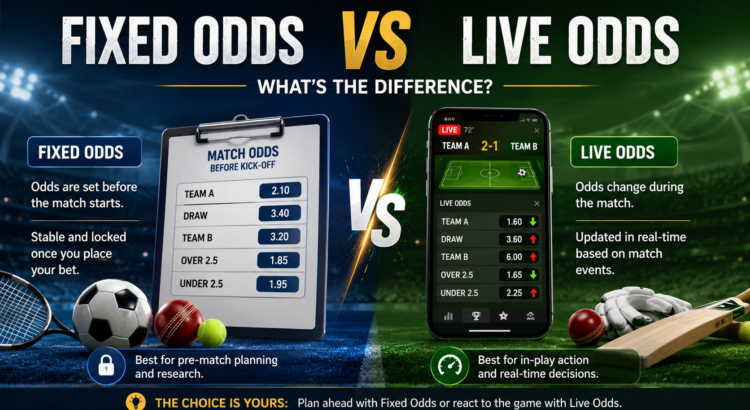
Sports betting gives users several ways to predict the outcome of a match, but two of the most common options are fixed odds and live odds. Although both are based on the same basic idea of predicting an outcome, the timing, information available, and way the odds move can be very different.
Understanding fixed odds vs live odds is important for anyone who wants to understand how sports betting markets work. Fixed odds provide a price before or during an event that is locked in once a bet is accepted, while live odds change as the match develops.
What Are Fixed Odds?
Fixed odds are betting prices that are agreed when a wager is accepted. Once the bet is placed, the odds attached to that bet generally remain unchanged, even if the market moves later.
For example, suppose a football team is offered at decimal odds of 2.00 before kick-off. If a bettor places a $50 wager at those odds and the bet wins, the total return would be $100, including the original stake.
The important point is that later changes do not normally affect the accepted price. This is one of the main features that makes fixed-odds betting straightforward to understand. The potential return is known when the wager is placed. Cambridge Dictionary similarly defines fixed-odds betting as betting where the amount that can be won does not change after the bet is made.
Fixed odds can be available across many sports and markets, including:
- Match winner
- Total goals or runs
- Player performance
- Handicap markets
- Tournament winners
- First-half or first-innings markets
What Are Live Odds?
Live odds, also called in-play odds, are prices offered while a sporting event is already taking place. Unlike fixed odds, they can change repeatedly as new information becomes available.
A football match is a simple example. Before kick-off, both teams may have relatively balanced prices. If one team scores an early goal, its chance of winning may increase in the market. The odds can then change to reflect the new match situation.
The same principle applies to cricket. A team’s live odds can react to runs, wickets, required run rate, overs remaining, partnerships, player performance and other match developments. Cricbet99’s existing live cricket betting coverage also highlights how these factors can cause odds to move during a match.
Because live markets respond to real-time events, the odds can move much faster than pre-match prices.
Fixed Odds vs Live Odds: Key Differences
The biggest difference between fixed odds and live odds is when the bet is placed and how the price behaves afterward.
| Feature | Fixed Odds | Live Odds |
| Betting time | Usually before the event | During the event |
| Price movement | Locked after acceptance | Changes continuously |
| Information | Pre-match information | Real-time match information |
| Decision-making | Based on preparation and research | Based on current match events |
| Market speed | Generally more stable | Often changes rapidly |
| Availability | Depends on the market | Depends on live market conditions |
Fixed odds can suit someone who prefers to make a decision before the match begins. Live odds may appeal to users who want to follow the action and consider new information as it becomes available.
Why Do Fixed Odds Change Before a Match?
The term “fixed” does not mean that the market price can never change. It means that your accepted price is fixed once the wager is placed.
For example, a football team might open at 2.10 and later move to 1.90 because of team news, injuries, weather, lineup announcements, or market activity. A person who placed the bet at 2.10 generally keeps that accepted price.
This distinction is important because many beginners confuse changing market prices with the settlement of an already accepted bet.
Why Do Live Odds Move So Quickly?
Live odds are designed to reflect the changing probability of an outcome. A major event can therefore cause an immediate price adjustment.
In football, a red card, penalty, goal, or serious injury can change the balance of a match.
In cricket, a wicket can have a similar impact. Consider a team chasing 180 runs in a T20 match. If it is 120/2 after 14 overs, the market may view the chase differently than it would at 90/5 after the same number of overs.
Other factors that can influence live cricket odds include:
- Current score
- Wickets in hand
- Required run rate
- Overs remaining
- Batter and bowler form
- Pitch conditions
- Weather interruptions
- Match momentum
This is why live betting requires attention to what is happening on the field rather than relying only on pre-match expectations.
Which Is Easier for Beginners?
For beginners, fixed odds can be easier to understand because the decision is made before the event and the accepted price is clear.
Live betting introduces an additional layer of complexity. Odds can change quickly, markets can be suspended around important events, and there may be less time to assess the available information.
That does not automatically make one format better than the other. The more useful approach is to understand how each market works before deciding whether it fits your preferences and level of experience.
For a broader explanation of sports betting odds, readers can also refer to established betting terminology resources and educational guides. The UNODC notes that fixed-odds betting allows the potential winning amount to be known in advance, while live betting involves wagering in real time during a competition.
How to Read Odds More Effectively
Regardless of whether the market is fixed or live, understanding the odds is essential.
With decimal odds, the basic calculation is:
Total Return = Stake × Decimal Odds
For example, a $20 stake at 2.50 odds would produce a potential total return of $50 if the prediction is successful.
However, odds should not be treated as a guarantee. A shorter price generally represents a market assessment of a higher likelihood, while a higher price indicates a lower implied probability. The actual result can still go either way.
Comparing markets, checking team news and understanding the factors behind price movements can provide useful context, but no betting method can remove uncertainty from sport.
Fixed Odds or Live Odds: Which Should You Choose?
There is no universal answer. The better option depends on how someone prefers to approach sports betting.
Fixed odds may be more suitable for people who like to research a match beforehand and make a decision without reacting to every development.
Live odds may be more suitable for those who closely follow matches and want to consider real-time information before making a decision.
The key difference is not simply the potential return. It is the amount and type of information available when the decision is made.
Responsible Betting Matters
Live betting can be particularly fast-paced, which can make it easier to make decisions without enough consideration. Setting a budget before betting, avoiding the temptation to chase losses, and treating betting as entertainment rather than a guaranteed source of income are important principles.
Users should also check whether sports betting is legally permitted in their location and use only properly authorised services where applicable. Gambling rules can differ significantly between countries and regions.
Frequently Asked Questions
Are fixed odds and live odds the same?
No. Fixed odds are locked once an accepted wager is placed, while live odds can change during an event as match conditions develop.
Can fixed odds change after I place a bet?
The market price can change after your wager, but the accepted price on a standard fixed-odds bet generally remains the price used for settlement.
Why do live odds change?
Live odds respond to events happening during a match, such as goals, wickets, injuries, red cards, score changes, and other factors that can alter the expected outcome.
Are live odds better than fixed odds?
Neither is automatically better. Fixed odds provide a more stable pre-match decision, while live odds allow decisions to be made using information from the match itself.
Can live odds change after every event?
Yes. Depending on the sport and market, prices can change after important events and sometimes very quickly. Markets may also be temporarily suspended around significant events.
What should beginners learn first?
Beginners should understand decimal odds, potential returns, basic sports markets, and the difference between pre-match and in-play betting before considering more complex markets.
Final Thought
The difference between fixed odds and live odds mainly comes down to timing and price movement. Fixed odds provide an agreed price when a bet is accepted, while live odds respond to what is happening during the sporting event.
For football, cricket, tennis, basketball, and other sports, understanding this distinction can make betting terminology much easier to follow. Rather than focusing only on changing numbers, it is useful to understand why those numbers move and what information is influencing the market.
Whether considering fixed or live markets, informed decision-making and responsible betting should always remain more important than chasing a particular price.