
Cristiano Ronaldo applauds fans after Portugal's final match at the FIFA World Cup 2026, marking the end of his World Cup career.

Cristiano Ronaldo’s Final FIFA World Cup Marks the End of an Extraordinary Era

Cristiano Ronaldo’s Final FIFA World Cup Marks the End of an Extraordinary Era

Every football generation is defined by a few legendary players, and Cristiano Ronaldo has undoubtedly been one of the greatest. Following Portugal’s heartbreaking Round of 16 defeat to Spain at the FIFA World Cup 2026, Ronaldo confirmed that this tournament was his final appearance on football’s biggest stage. The announcement closed one of the most remarkable World Cup journeys in history and left millions of fans reflecting on an unforgettable career.

Although Portugal’s campaign ended earlier than expected, Ronaldo’s influence extends far beyond one result. His career has been built on relentless ambition, consistency, and an unmatched desire to compete at the highest level. Even at 41, he remained Portugal’s captain and a key figure both on and off the pitch.

A Historic Farewell at FIFA World Cup 2026

Portugal entered the knockout stage with hopes of making another deep World Cup run. However, Spain’s disciplined defensive display and Mikel Merino’s dramatic stoppage-time winner ended those dreams with a narrow 1-0 victory. The defeat also marked what Ronaldo later confirmed was his final FIFA World Cup appearance.

Despite the emotional exit, Ronaldo chose to focus on gratitude instead of disappointment. He expressed pride in everything he had achieved with Portugal while making it clear that he would take time before deciding his overall international future. His confirmation officially closed a World Cup journey that began nearly two decades ago.

Cristiano Ronaldo’s Remarkable FIFA World Cup Journey

Very few players have remained relevant across multiple generations, but Ronaldo achieved exactly that.

His World Cup story includes appearances across five different eras of football, facing changing tactics, new rivals, and evolving squads while continuing to lead Portugal.

Some of his biggest World Cup achievements include:

  • Multiple FIFA World Cup appearances spanning nearly two decades.
  • Goals scored in several different World Cup tournaments.
  • Portugal captain throughout numerous major international competitions.
  • Consistent performances against the world’s strongest national teams.
  • Becoming one of football’s greatest ambassadors on the global stage.

While lifting the FIFA World Cup trophy remained the one major achievement missing from his collection, his impact on the tournament cannot be measured only by titles.

Career Highlights That Built a Global Icon

Cristiano Ronaldo’s legacy extends far beyond the World Cup.

Throughout his professional career, he consistently broke records that once appeared untouchable.

Among his greatest accomplishments are:

  • Five UEFA Champions League titles.
  • UEFA Euro 2016 champion with Portugal.
  • UEFA Nations League titles.
  • Five Ballon d’Or awards.
  • Record-breaking goal scorer for Portugal.
  • One of football’s all-time leading goalscorers.
  • Success across England, Spain, Italy, and Saudi Arabian football.

His ability to reinvent himself throughout different stages of his career separated him from nearly every player of his generation. Whether playing as a winger, striker, or central forward, Ronaldo continuously adapted his game while maintaining elite performance levels.

More Than Statistics: Ronaldo’s Lasting Legacy

Football fans often debate whether trophies or statistics define greatness.

Cristiano Ronaldo’s career proves that legacy is built through consistency, professionalism, leadership, and the ability to inspire millions.

Young footballers around the world continue to admire:

  • His incredible work ethic.
  • Physical fitness even into his forties.
  • Mental toughness under pressure.
  • Dedication to continuous improvement.
  • Leadership for both club and country.

Even critics acknowledge the remarkable discipline required to remain among football’s elite for more than twenty years.

His influence extends beyond the pitch through charity work, global popularity, and the motivation he has provided to aspiring athletes worldwide.

Portugal’s Future After Ronaldo

Ronaldo’s departure from the World Cup also represents the beginning of a new era for Portugal.

The national team now features exciting younger talents capable of carrying the country’s ambitions forward. Players like Gonçalo Ramos, João Neves, Rafael Leão, Vitinha, and others have already demonstrated their quality on the international stage.

Although replacing Ronaldo’s leadership will be nearly impossible, Portugal’s future remains bright thanks to its strong youth development system and talented squad.

His legacy will continue to shape Portuguese football long after his playing career eventually comes to an end.

Why Cristiano Ronaldo Will Always Be Remembered

Great players win trophies.

Legends change the sport itself.

Cristiano Ronaldo transformed expectations around longevity, professionalism, and elite performance. He showed that dedication could extend careers well beyond traditional limits while inspiring generations of footballers to dream bigger.

Even supporters of rival teams acknowledge the impact he has had on football history.

His final FIFA World Cup may not have ended with the trophy he always desired, but it concluded a journey that millions will remember for decades.

FAQs

Did Cristiano Ronaldo confirm that FIFA World Cup 2026 was his final World Cup?

Yes. Following Portugal’s elimination against Spain, Ronaldo confirmed that the 2026 FIFA World Cup was his final appearance in the tournament while delaying a decision regarding his complete international retirement.

How did Portugal exit the FIFA World Cup 2026?

Portugal lost 1-0 to Spain in the Round of 16 after Mikel Merino scored a dramatic stoppage-time winner.

What are Cristiano Ronaldo’s biggest international achievements?

His greatest international honors include winning UEFA Euro 2016 and two UEFA Nations League titles while becoming Portugal’s all-time leading scorer and most-capped player.

Why is Cristiano Ronaldo considered one of football’s greatest players?

His combination of longevity, goal-scoring consistency, leadership, individual awards, club success across multiple leagues, and international achievements has established him as one of football’s greatest players.

Final Thought

Cristiano Ronaldo’s final FIFA World Cup represents more than the end of a tournament—it marks the closing chapter of one of football’s most extraordinary international careers. While Portugal’s defeat to Spain ended his World Cup dream, it did nothing to diminish the incredible legacy he leaves behind. From unforgettable goals and record-breaking achievements to inspiring millions with his determination and professionalism, Ronaldo has redefined what is possible in modern football. Future generations will study his career not simply because of the trophies he won, but because of the standards he set for excellence.
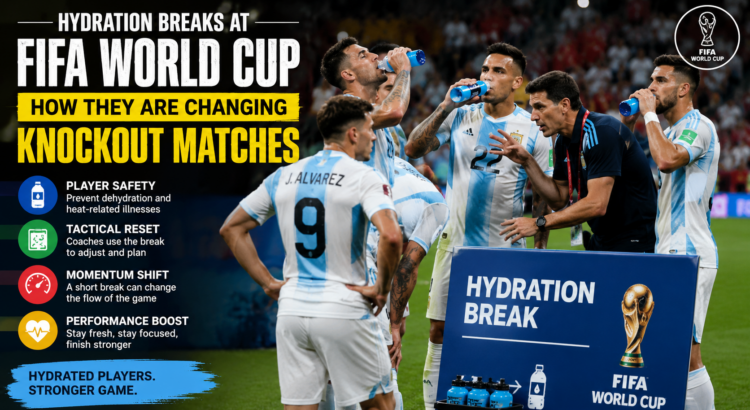
Players take a hydration break during a FIFA World Cup knockout match while coaches deliver tactical instructions from the sidelines.

Hydration Breaks at the FIFA World Cup: How They Are Changing Knockout Matches

Hydration Breaks at the FIFA World Cup: How They Are Changing Knockout Matches

The FIFA World Cup has always been a stage where tactics, fitness, and mental strength determine who advances and who goes home. In recent tournaments, however, one additional factor has started influencing the flow of knockout matches—hydration breaks. Initially introduced to protect players competing in extreme heat and humidity, these scheduled pauses have evolved into important tactical moments that can reshape the outcome of high-pressure games.

While the primary purpose of hydration breaks is player welfare, coaches, players, and fans have increasingly recognized their strategic value. From altering momentum to allowing tactical adjustments, these brief interruptions can have a lasting impact on the biggest matches in international football.

Why Hydration Breaks Are Necessary

Football is one of the most physically demanding sports in the world. During a World Cup knockout match, players can cover more than 10 kilometers while repeatedly sprinting, pressing, and changing direction. When matches are played in high temperatures or humid conditions, the physical strain becomes even greater.

Hydration breaks are designed to help players:

  • Replace lost fluids.
  • Reduce the risk of heat-related illnesses.
  • Improve concentration during long matches.
  • Maintain physical performance in challenging weather.

Medical experts have consistently emphasized that dehydration can reduce reaction time, decision-making, and endurance. In knockout football, even a slight decline in performance can prove decisive.

More Than Just a Water Break

Although hydration breaks usually last only a few minutes, they often resemble mini team talks.

Managers use the opportunity to:

  • Adjust formations.
  • Correct defensive mistakes.
  • Change pressing intensity.
  • Discuss set-piece strategies.
  • Calm players after periods of sustained pressure.

Unlike substitutions, which change personnel, hydration breaks allow coaches to reorganize the entire team’s approach without interrupting the match significantly.

This has made the breaks an increasingly important tactical tool during World Cup knockout fixtures.

Momentum Can Change in Minutes

One of the biggest debates surrounding hydration breaks is their effect on momentum.

Football is heavily influenced by rhythm. Teams dominating possession or creating repeated chances often rely on maintaining continuous pressure. A scheduled break can interrupt that flow and give struggling opponents valuable time to regroup.

For example, if one team has spent 15 minutes defending deep under constant pressure, a hydration break provides:

  • Time to recover physically.
  • An opportunity to reorganize defensively.
  • A chance for the coaching staff to identify weaknesses.

When play resumes, the momentum may shift dramatically.

Conversely, teams already controlling the match can use the pause to refine their attacking approach and ensure concentration levels remain high.

A Bigger Factor During Knockout Matches

Group-stage matches allow room for recovery after a poor result. Knockout matches do not.

Every tactical decision carries greater importance because a single mistake can end a nation’s World Cup campaign.

Hydration breaks become especially valuable because coaches can:

  • Prepare for extra time.
  • Manage player fatigue.
  • Reduce unnecessary pressing.
  • Plan substitution strategies.
  • Reinforce defensive discipline.

Since knockout matches frequently extend beyond 90 minutes, conserving energy becomes almost as important as creating scoring chances.

The Role of Sports Science

Modern football relies heavily on sports science.

Teams monitor player workload using GPS tracking, heart-rate monitors, and performance data. Hydration strategies are now tailored for individual players based on:

  • Sweat rate.
  • Temperature.
  • Humidity.
  • Playing position.
  • Physical workload.

Sports scientists work alongside medical staff to determine how much fluid and electrolytes each player requires throughout a match.

These small details help players maintain peak performance when every sprint and tackle matters.

Tactical Communication Has Improved

International managers spend limited time working with national teams compared to club football. Every opportunity for communication is valuable.

Hydration breaks provide a legal opportunity for:

  • Tactical reminders.
  • Leadership discussions.
  • Motivation.
  • Clarifying defensive assignments.

Captains also play an important role by ensuring teammates understand the revised game plan before play resumes.

Critics Still Raise Concerns

Despite the obvious health benefits, hydration breaks have attracted criticism.

Some supporters believe they interrupt the natural rhythm of football, especially when one team has built strong attacking momentum.

Others argue that broadcasters may benefit from the additional pause because it creates a convenient window for television coverage and advertisements.

However, football’s governing bodies have consistently maintained that player safety remains the primary reason for introducing hydration breaks during extreme weather conditions.

Could Hydration Breaks Become Permanent?

As climate conditions become increasingly unpredictable and international tournaments expand into regions with challenging weather, hydration breaks may become a more common feature of elite football.

Future tournaments could see even greater emphasis on:

  • Heat monitoring.
  • Player recovery.
  • Medical protocols.
  • Environmental safety standards.

Rather than being viewed as interruptions, hydration breaks may eventually become a standard part of modern football whenever conditions require them.

Final Thoughts

Hydration breaks have become much more than short pauses for players to drink water. They now represent a unique blend of sports science, tactical planning, and player welfare. In FIFA World Cup knockout matches, where every decision can define a nation’s journey, these brief intervals often provide the opportunity to reset, rethink, and respond.

Whether they shift momentum, improve player safety, or allow coaches to make crucial tactical adjustments, hydration breaks have established themselves as an important element of the modern game. As football continues to evolve alongside advances in sports science and changing climate conditions, their influence is likely to grow even further.

Frequently Asked Questions (FAQs)

Why are hydration breaks used during the FIFA World Cup?

Hydration breaks help players stay safe and maintain performance when matches are played in high temperatures or humid conditions.

Do hydration breaks affect match momentum?

Yes. They can interrupt a team’s attacking rhythm while giving opponents time to recover physically and reorganize tactically.

Can coaches give instructions during hydration breaks?

Yes. Coaches often use the break to communicate tactical changes, motivate players, and prepare for the remainder of the match.

Are hydration breaks mandatory?

They are typically introduced when weather conditions meet specific heat-related safety thresholds set by competition organizers and match officials.

Do hydration breaks help reduce injuries?

While they cannot eliminate injuries entirely, they reduce the risk of heat stress, dehydration, and fatigue-related performance decline.