Suspended and cancelled betting markets explained

Understanding Suspended and Cancelled Betting Markets

Sports betting can look straightforward when you select a team, choose a market, and confirm your wager. However, betting markets can sometimes disappear, stop accepting wagers, or become cancelled altogether. For new and experienced bettors, understanding why this happens is important because a suspended betting market and a cancelled betting market do not necessarily mean the same thing.

A market may be suspended temporarily because something important is happening during an event. A market may also be cancelled when the operator can no longer settle it according to the applicable rules. The exact treatment depends on the sportsbook, sport, market type, and circumstances surrounding the event.

Knowing these differences can make betting statements and settlement updates much easier to understand.

What Is a Suspended Betting Market?

A suspended betting market is a market that has temporarily stopped accepting new bets.

This is particularly common during live sporting events. For example, imagine a football match where a penalty is awarded. The sportsbook may immediately suspend markets such as the next goal, match result, or player scoring markets while the situation is being reviewed.

Suspension helps operators update odds and reduce the possibility of bets being accepted after important information has become known.

Live betting can involve rapidly changing information, so markets may be suspended for only a few seconds before reopening with updated prices. In other situations, a market can remain suspended for longer because the operator is waiting for confirmation of an injury, score, VAR decision, weather interruption, or another significant development.

Betfair’s rules, for example, explain that bets matched after certain material events may be voided if the market was not suspended in time.

Why Do Sportsbooks Suspend Markets?

There are several common reasons behind a suspended market.

1. A Major Event Happens

Goals, wickets, red cards, penalties, injuries, knockouts, and other decisive moments can cause an immediate suspension.

2. Official Information Is Being Confirmed

A sportsbook may temporarily stop a market while checking an official score, result, player status, or referee decision.

3. Technical Problems

Connection issues, incorrect data feeds, or other technical problems can affect live odds. Suspending the market gives the operator time to correct the information.

4. Unusual Betting Activity

In some situations, unusual activity can lead to a market being reviewed before betting is reopened.

A suspension therefore does not automatically mean that something is wrong with your account or your existing wager. In many cases, it is simply part of normal sportsbook risk management.

What Is a Cancelled Betting Market?

A cancelled betting market is different because cancellation generally means the market will not continue in its original form.

When a market is cancelled or declared void, accepted bets may be settled according to the sportsbook’s rules, which can include returning the original stake. The exact outcome depends on the specific terms attached to the market.

For example, if a sporting event is abandoned and cannot be completed within the timeframe specified by the operator, affected markets may be declared void.

Betfair states that where an event is not completed within its specified period, bets on affected markets can be void unless the outcome of a particular market has already been unconditionally determined.

Similarly, current FanDuel sportsbook rules explain that certain cancelled or abandoned events can result in bets being void, while markets whose outcomes were already determined may be treated differently.

Suspended vs Cancelled Betting Markets

The easiest way to understand the difference is to think about temporary interruption versus final settlement treatment.

A suspended market is usually temporary. The sportsbook may reopen it once the relevant situation has been resolved and updated odds are available.

A cancelled market generally indicates that the market will not proceed under the original conditions. Depending on the rules, bets may be voided and stakes returned.

For instance, if a cricket match is temporarily interrupted because of rain, some markets might simply be suspended while officials assess whether play can resume. If the match is eventually abandoned and the required conditions for settlement are not met, certain markets could then be cancelled or voided.

Singapore’s official sports betting rules also demonstrate why settlement can depend on the individual bet type when an event is postponed, suspended, abandoned, or cancelled.

What Happens to Your Bet After a Market Is Suspended?

If you have already placed an accepted bet before a market is suspended, the suspension does not automatically cancel that wager.

The bet normally remains active while the sportsbook waits for the market to reopen or for the event to reach a settlement point. However, if circumstances later require the market to be voided, the operator will apply its published rules.

This is why it is important to distinguish between a market being unavailable for new wagers and an already accepted bet being cancelled.

Before placing sports bets, users should always check the operator’s rules for the specific sport and market.

What Happens When a Market Is Cancelled?

If a market is cancelled and declared void, the usual outcome is that affected bets are returned according to the operator’s terms.

However, there can be exceptions. Some markets may already have a definite outcome before an event is abandoned. In such cases, the sportsbook may settle that particular market rather than voiding it.

The treatment can also vary between sports. Tennis, cricket, football, basketball, and horse racing all have different event structures, so the rules surrounding player withdrawals, postponements, interruptions, and abandoned events can differ.

For official regulatory context, the Singapore Gambling Control Act defines betting broadly in relation to sporting events and other outcomes, while licensed operators remain subject to applicable rules and conditions.

How to Read Betting Market Status Correctly

A few simple habits can help avoid confusion.

First, check whether the market says suspended, cancelled, or void. These terms can have different meanings.

Second, read the sportsbook’s sport-specific rules. Do not assume that a rule applying to football will automatically apply to tennis or cricket.

Third, check the event status. A postponement, abandonment, resumption, or venue change can affect settlement.

Finally, keep your bet confirmation and settlement details. If something appears inconsistent, these records can help when contacting customer support.

If you are comparing sportsbook-related information or researching different betting platforms, you may also come across resources such as Cricbet99 while looking at sports betting options and market-related information.

Why Market Rules Matter for Bettors

Betting odds are only one part of understanding a wager. The settlement rules are equally important.

A market can appear attractive because of its price, but unusual circumstances may change how that market is treated. A player withdrawal, abandoned match, incorrect data, or event postponement can all affect settlement depending on the operator’s terms.

Understanding suspended and cancelled betting markets therefore helps bettors interpret what happens after a bet has been placed rather than focusing only on the odds displayed before the event.

The best approach is to treat sportsbook rules as part of the market itself. Before placing a wager, knowing how the operator handles interruptions, cancellations, postponements, and voids can prevent unnecessary confusion later.

FAQs

What does a suspended betting market mean?

A suspended betting market means the sportsbook has temporarily stopped accepting new bets. It may reopen after an important event or piece of information has been confirmed.

Does a suspended market mean my bet is cancelled?

No. A suspension does not automatically cancel previously accepted bets. The existing wager is normally handled according to the sportsbook’s settlement rules.

What does a cancelled betting market mean?

A cancelled market generally means the market will not continue under its original conditions. Depending on the rules, affected bets may be declared void and stakes returned.

Why are live betting markets suspended?

Live markets can be suspended when a goal, wicket, penalty, injury, card, VAR review, or another important event occurs. This allows the sportsbook to update information and odds.

Can a cancelled market still be settled?

In some circumstances, yes. If the outcome of a particular market was already unconditionally determined before an event was abandoned or cancelled, the sportsbook’s rules may allow that market to be settled.

Are suspended and cancelled markets the same?

No. Suspension is generally temporary, while cancellation usually indicates that the market will not proceed under its original conditions.

Final Thought

Suspended and cancelled betting markets are a normal part of modern sports betting. A suspension usually represents a temporary pause while important information is assessed, whereas a cancellation can lead to a market being voided under the operator’s rules.

The key is not to assume that every sportsbook handles unusual situations in exactly the same way. Checking the specific market rules, understanding the event status, and keeping track of settlement information can make the process much clearer.

For anyone interested in sports betting, understanding these basic terms is just as valuable as understanding odds. It provides a clearer picture of what can happen to a wager when a sporting event does not follow its expected course.


Understanding void bets across different sports

Understanding Void Bets Across Different Sports

Sports betting involves more than simply predicting which team or player will win. Every wager is settled according to specific rules, and sometimes a bet does not result in either a win or a loss. This is where void bets come into play.

A void bet is generally a wager that is cancelled because the conditions required for the market to stand were not met. In many cases, the original stake is returned, meaning the bet is treated as though it had not been placed. However, the exact reason for a void and the way it is settled can vary between sports, markets, and betting operators.

Understanding these rules is important for anyone who follows sports betting because a postponed football match, a retired tennis player, or a shortened cricket match can all affect how a wager is settled.

What Is a Void Bet?

A void bet means that a bookmaker or betting platform has cancelled the wager under its published rules. Unlike a losing bet, the selection is not considered unsuccessful. A standard void bet is normally settled at odds of 1.00, with the original stake returned.

For example, suppose a bettor places $20 on a football match that is later cancelled and does not take place within the operator’s specified settlement period. If the market is voided, the bettor normally receives the $20 stake back rather than losing it.

The important point is that void does not mean loss. It simply means the bet could not be settled under the normal conditions of that market.

Betting operators are generally expected to explain the circumstances in which bets may be voided within their published rules. The UK Gambling Commission, for example, requires licensed operators to set out the circumstances under which a bet can be voided.

Why Do Sports Bets Become Void?

There are several common reasons a wager may be cancelled.

Postponed or Abandoned Events

A match may be postponed because of bad weather, venue problems, security concerns, or other circumstances. If the event is not completed within the timeframe specified by the operator, affected markets may be voided.

The same principle can apply when an event starts but is later abandoned. However, the result depends on the sport and the particular market. Some markets may stand if their outcome has already been determined, while others may be cancelled.

Non-Participation

Player markets can also become void when the selected athlete does not participate.

For example, a basketball player may be ruled out before the game begins, or a football player may be listed in the expected lineup but never enter the match. Depending on the operator’s rules, a player-specific wager may be void and the stake returned.

This is particularly important for bettors who use player-prop markets because participation rules can differ from one sport to another.

Changes to the Event

Changes involving the venue, playing surface, competition format, or event conditions can sometimes affect settlement.

Not every change automatically creates a void bet. Some operators allow the wager to stand when the core event remains the same, while others have specific conditions for certain markets.

That is why checking the rules attached to a particular market is more reliable than assuming every bookmaker uses the same policy.

Void Bets in Football

Football provides several common examples of void betting situations.

If a match is postponed, the operator may allow the original bets to remain active if the fixture is rearranged within its specified timeframe. If it is not played within that period, unsettled markets may be void.

Abandoned matches can be more complicated. For example, if a match is stopped after a particular result has already been determined for a market, that market may stand while other unsettled markets are cancelled.

Player markets can also have separate rules. A wager on a player to score may be void if that player never participates, while a match-result wager could remain active.

The key lesson is simple: football void bet rules can depend on both the event and the market selected.

Void Bets in Cricket

Cricket has its own set of circumstances that can affect betting settlement.

Weather interruptions are one of the most obvious examples. A match may be shortened because of rain, while some markets may require a minimum number of overs or a specific amount of play before they can be settled.

For instance, a market based on total team runs may have a minimum-overs condition. If the match is reduced below that threshold, the market could be void according to the applicable rules.

Player participation can also matter. A player-specific market may be cancelled if the selected player does not take part in the relevant event.

Because cricket formats range from T20 matches to Tests, the rules for one market should never automatically be assumed to apply to another. Specific cricket betting rules can contain conditions for shortened matches, player specials, innings markets, and series bets.

Void Bets in Tennis

Tennis is particularly interesting because retirements can create different settlement outcomes.

If a player withdraws before the match begins, bets on the match may be void. However, once play has started, some markets may continue to stand while others can be cancelled if the match ends prematurely.

For example, a set-winner market may already have a definite result if the set has been completed. A full-match market may have a different settlement rule if a player retires during the following set.

Current sportsbook rules show that retirement, disqualification, and walkovers can be treated differently depending on the market.

This makes it especially important to read tennis-specific settlement rules before placing wagers on match or player markets.

What Happens to Void Bets in Accumulators?

A common misunderstanding is that one void selection automatically destroys an entire accumulator.

In a standard multiple bet, a void selection is often removed from the calculation and treated at odds of 1.00. The remaining selections continue to determine the final payout.

For example, imagine a four-leg accumulator containing four selections. If one selection is void, the bet may effectively become a three-selection accumulator using the remaining odds.

However, promotional bets, bet builders, and certain enhanced multiples may have different terms. Always check the conditions attached to the specific bet rather than assuming the standard accumulator rule applies.

Void Bet vs Push vs Loss

These terms are sometimes confused, but they are not necessarily interchangeable.

A void bet is cancelled because the conditions for settlement were not satisfied.

A push usually occurs when the final result exactly matches the betting line, such as a handicap or total that finishes on the stated number. The stake is commonly returned.

A loss occurs when the selection fails to meet the conditions of the wager.

Understanding the difference can make it much easier to read a betting statement and understand why a particular balance changed.

How to Avoid Confusion With Void Bets

Bettors cannot always prevent an event from being postponed or a player from withdrawing, but they can reduce confusion by checking the rules before placing a wager.

Look at the sport-specific rules, market conditions, participation requirements, and minimum-event requirements. It is also useful to understand how void selections affect accumulators.

For additional information about responsible betting and regulatory standards, the UK Gambling Commission’s betting rules provide useful background on how betting operators should present settlement conditions.

When comparing sports betting platforms, bettors should also review the operator’s own terms instead of relying on general assumptions. If you are researching online sports betting options, you can also check Cricbet99 for more information related to sports betting.

Frequently Asked Questions

What does a void bet mean?

A void bet is a wager that has been cancelled under the applicable betting rules. In a standard case, the original stake is returned and the bet is not counted as a win or loss.

Do I lose my money if a bet is void?

Normally, no. A standard void bet is settled at odds of 1.00, meaning the original stake is returned. However, the exact settlement should always be checked against the operator’s rules.

Can a football match be voided after it starts?

Yes. If a match is abandoned and the relevant markets have not been conclusively determined, those markets may be void depending on the operator’s rules and any rescheduling conditions.

What happens if a tennis player retires?

It depends on the market and the sportsbook’s rules. Some completed markets may stand, while unsettled match markets may be void after a retirement.

Can cricket bets become void because of rain?

Yes. If weather reduces a match below the minimum conditions required for a particular market, that market may be void. The requirements can differ between formats and markets.

Does one void selection cancel an accumulator?

Usually, a void selection is removed from a standard accumulator and the remaining selections continue. Some promotions and special bet types may use different settlement conditions.

Final Thought

Void bets are a normal part of sports betting settlement and do not automatically indicate that something went wrong with a wager. They usually arise because an event was postponed, abandoned, shortened, or affected by a player or participant not taking part.

The most important thing to remember is that void bet rules are not identical across every sport or betting market. Football, cricket, and tennis can each have different settlement conditions, particularly when events are interrupted or players do not participate.

Taking a few moments to read the relevant market rules before placing a wager can prevent confusion later. Understanding how void bets work also makes betting statements, accumulators, and settlement results much easier to interpret.

Betting market settlement rules for sports betting

Understanding Betting Market Settlement Rules in Sports

Sports betting can look straightforward when you are simply choosing a team, player, or total. However, understanding what happens after the event is just as important as selecting a bet. A market may be settled as a win, loss, void, or sometimes according to a specific competition rule.

This is why understanding betting market settlement rules matters. Settlement determines whether a wager qualifies for a return and which result is used when a match is postponed, abandoned, interrupted, or affected by unusual circumstances.

For cricket fans in particular, these details can become important because weather interruptions, reduced overs, no-results, Super Overs, and official match decisions can all affect how an event is completed.

What Are Betting Market Settlement Rules?

Betting market settlement rules are the conditions used by a sportsbook or betting operator to determine the final outcome of a wager.

The rules can vary depending on the sport and the specific market. For example, a full-match winner market may depend on the official result, while a first-to-score market could already be decided before a match is abandoned.

The key point is that the result of a sporting event and the settlement of an individual betting market are not always exactly the same thing.

Before placing a wager, bettors should therefore check the operator’s rules for the relevant sport and market.

Why Settlement Rules Matter

Imagine a cricket match begins but heavy rain prevents it from reaching the required number of overs. The official competition rules might declare the match a no result.

That does not automatically tell you how every betting market will be handled.

Some markets may depend on an outcome that was already established, while others may be void because the event did not reach the required stage. Different operators can also have different conditions concerning postponed or abandoned events.

For example, some sportsbook rules state that undecided markets can become void when a match is abandoned, while markets that were already fully determined may still stand.

This is why reading the specific settlement conditions is more useful than relying on assumptions.

Common Types of Sports Betting Markets

Sportsbooks offer many different markets, and each can have its own settlement conditions.

Match Winner

This is one of the simplest markets. The selection is based on which team or player officially wins the contest.

However, a draw, abandoned match, postponed event, or competition-specific tiebreaker can change how the market is settled.

Over and Under Markets

Totals markets involve predicting whether a statistic will finish above or below a specified number.

Examples include total runs in cricket, goals in football, or points in basketball.

Rules can specify whether extra time, Super Overs, overtime, or other additional periods count. The exact wording of the market is therefore important.

Player Performance Markets

These markets may involve runs, wickets, goals, points, assists, or other individual statistics.

Player participation can become especially important. A sportsbook may require a player to start the match for a bet to stand, depending on its specific rules.

First or Next Event Markets

Markets such as first team to score, next wicket, or first goalscorer can sometimes be settled before the entire match reaches its conclusion.

If the event has already happened and the market outcome cannot change, some betting rules allow that market to stand even if the wider match is later abandoned.

What Happens When a Match Is Postponed?

A postponed match does not necessarily mean every bet is immediately cancelled.

The treatment depends on the sportsbook’s rules. Some operators allow bets to remain active when the match is completed within a specified period, while others may void wagers if the event is not played within the stated timeframe.

This is particularly relevant for accumulator bets. If one selection is voided, the overall bet may be recalculated according to the operator’s accumulator rules.

For this reason, checking the postponement section before placing a wager can prevent unpleasant surprises later.

Abandoned Matches and Void Bets

An abandoned match creates one of the most common settlement questions.

A void bet generally means the wager is cancelled and the stake is returned, although the exact treatment can differ between operators and markets.

The important distinction is whether the market had already been unconditionally determined.

For example, if a particular player has already scored the first goal and the relevant market is fully decided before the match is abandoned, some sportsbook rules allow that market to be settled. An undecided match-winner market, meanwhile, may be void.

The same principle can apply across different sports, although the exact conditions vary.

Cricket Makes Settlement Especially Interesting

Cricket provides several examples of why settlement rules need careful attention.

International cricket has specific playing conditions covering results, no results, abandoned matches, and reduced-over situations. The ICC’s current playing-conditions resources provide the official framework used for its competitions.

For example, ICC playing conditions can distinguish between a completed match and a no-result situation depending on whether the required number of overs has been played.

This distinction can be important when considering markets connected to match winners, totals, innings performance, or player statistics.

A bettor should not assume that a score shown during a rain-affected match will automatically become the final settlement result.

Official Results Are Usually Important

Another major factor is the official result provided by the relevant sporting authority.

Sportsbook rules commonly refer to official governing-body results when determining how markets should be settled. For example, Betfair’s general rules state that where specific sports rules do not provide another method, markets are settled using the official result of the relevant governing body.

For cricket, the ICC’s official playing conditions are a useful reference when understanding how official match outcomes are determined.

This highlights an important principle: live scores, unofficial reports, or social media updates should not automatically be treated as the final settlement authority.

How Bettors Can Avoid Settlement Confusion

The easiest way to reduce confusion is to check the rules before placing the bet.

Look for information covering:

  • Postponed matches
  • Abandoned events
  • No-result situations
  • Extra time or Super Overs
  • Overtime
  • Player participation
  • Official results
  • Void markets
  • Dead heats
  • Minimum playing requirements

It is also useful to understand the difference between a market being void and a bet being lost. A losing bet means the selection was unsuccessful. A void bet generally means the market did not meet the conditions required for settlement.

If you are comparing betting platforms, examining these rules can be just as valuable as comparing the displayed odds.

Final Thought

Sports betting is not only about predicting what happens on the field. Knowing what happens after the final whistle—or after an interruption—is equally important.

From postponed football matches to rain-affected cricket games, settlement conditions determine how individual markets are treated. Understanding the rules around official results, abandoned events, void bets, and already-determined markets can make the betting process much clearer.

The smartest approach is simple: never assume that every market is settled in the same way. Check the sport-specific and market-specific conditions before placing a wager, and use official sporting sources when you need to understand how an event itself was decided.

FAQs

What are betting market settlement rules?

They are the conditions used by a sportsbook to determine whether a wager is won, lost, void, or otherwise settled after an event.

What happens if a sports match is abandoned?

It depends on the sportsbook and market. Undecided markets may be void, while markets whose outcomes were already fully determined may still be settled.

Does a postponed match automatically void a bet?

Not necessarily. Some operators keep bets active if the event is completed within a specified timeframe. Always check the operator’s postponement rules.

Why are cricket settlement rules complicated?

Cricket can involve rain interruptions, reduced overs, no-results, Duckworth-Lewis-Stern calculations, reserve days, and Super Overs. These situations can affect both the official result and individual betting markets.

Where can I check official cricket playing conditions?

The International Cricket Council publishes current playing conditions and competition regulations on its official website.

Is a void bet the same as a losing bet?

No. A losing bet means the selected outcome did not win. A void bet generally means the market could not be settled under its stated conditions, so the stake is normally returned according to the operator’s rules.

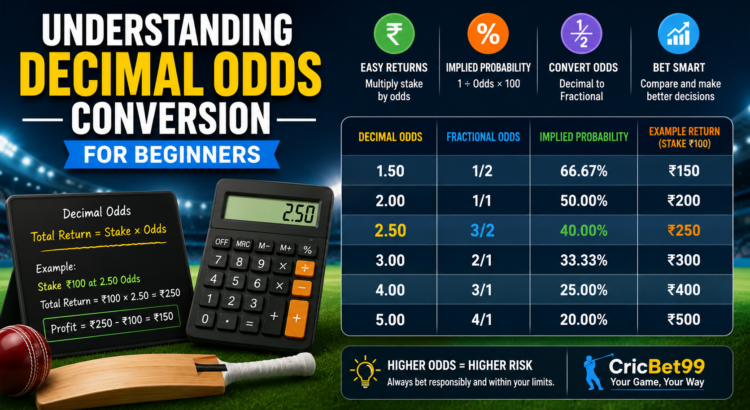
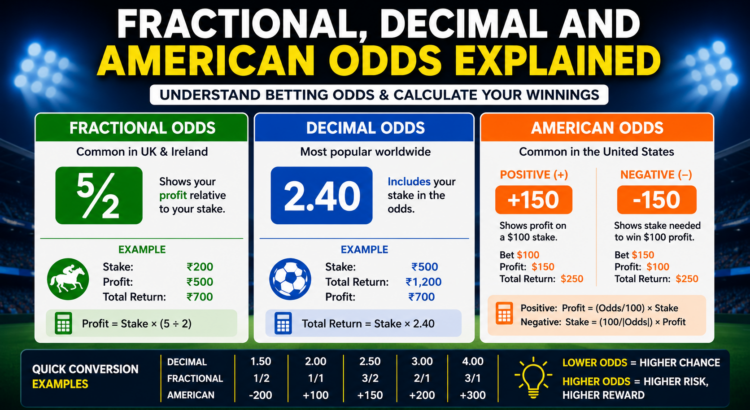
Decimal odds conversion guide showing odds, implied probability, and potential betting returns

Understanding Decimal Odds Conversion for Beginners

For anyone new to sports betting, the numbers displayed beside teams or players can look confusing at first. Decimal odds are one of the simplest formats to understand, but knowing how to convert them into percentages, fractional odds, and potential returns makes them much easier to use.

Whether you are checking cricket, football, tennis, or another sport, understanding decimal odds conversion can help you read betting markets more clearly and compare different prices without relying on guesswork.

What Are Decimal Odds?

Decimal odds show the total return you would receive for every unit of money staked if your selection wins. Importantly, the return includes your original stake.

For example, suppose a cricket team is offered at 2.50 decimal odds and you place a ₹100 stake.

The calculation is:

₹100 × 2.50 = ₹250 total return

Your original ₹100 is included in that amount, so your net profit would be ₹150.

This is one reason decimal odds are popular: the calculation is straightforward. You simply multiply your stake by the displayed odds. Betfair also explains decimal odds in this way, noting that the stake is included in the total return.

Why Decimal Odds Are Easy for Beginners

Decimal odds remove much of the confusion associated with traditional fractional odds.

For instance:

  • 2.00 decimal = even money
  • 2.50 decimal = 3/2 fractional
  • 3.00 decimal = 2/1 fractional
  • 4.00 decimal = 3/1 fractional
  • 5.00 decimal = 4/1 fractional

Instead of calculating fractions first, you can immediately see the potential total return.

A simple rule is worth remembering:

Higher decimal odds generally indicate a lower implied probability, while lower decimal odds indicate a higher implied probability.

However, odds are not a guarantee of what will happen in a sporting event. They represent a price offered by a betting market.

How to Calculate Potential Returns

The basic formula is:

Total Return = Stake × Decimal Odds

Imagine you are looking at a cricket match and one team is priced at 1.80.

With a ₹500 stake:

₹500 × 1.80 = ₹900 total return

Your net profit would therefore be:

₹900 − ₹500 = ₹400

Now consider odds of 3.50 with the same ₹500 stake:

₹500 × 3.50 = ₹1,750 total return

The net profit would be ₹1,250.

The key difference is that decimal odds already include your original stake. You should not add the stake again after performing the multiplication.

Decimal Odds to Implied Probability

One of the most useful decimal odds conversions is turning odds into an implied probability.

The formula is:

Implied Probability = 1 ÷ Decimal Odds × 100

For example, if the odds are 2.00:

1 ÷ 2.00 × 100 = 50%

At 4.00:

1 ÷ 4.00 × 100 = 25%

And at 1.50:

1 ÷ 1.50 × 100 = 66.67%

Betfair provides the same basic calculation, explaining that implied probability can be calculated by dividing 100 by the decimal odds.

Remember that this is an implied probability, not a guarantee that an event has exactly that chance of happening. Bookmaker margins, market conditions, and other factors can affect the price.

Converting Decimal Odds to Fractional Odds

Converting decimal odds into fractional odds is also simple.

The formula is:

Fractional Odds = Decimal Odds − 1

For example:

2.50 − 1 = 1.50

This can be written as 3/2.

Another example:

4.00 − 1 = 3.00

So, 4.00 decimal odds are equivalent to 3/1 fractional odds.

Here are a few common examples:

Decimal OddsFractional OddsImplied Probability
1.251/480%
1.501/266.67%
2.001/150%
2.503/240%
3.002/133.33%
4.003/125%
5.004/120%

The conversion relationship between decimal and traditional odds is also documented by Betfair: subtracting 1 from decimal odds gives the equivalent fractional price.

A Cricket Betting Example

Suppose a cricket match has these prices:

  • Team A — 1.70
  • Team B — 2.20

If you wanted to calculate the implied probability of Team A:

1 ÷ 1.70 × 100 = 58.82%

For Team B:

1 ÷ 2.20 × 100 = 45.45%

Notice that the percentages add up to more than 100%. That can happen because bookmaker prices can include a margin, often called the overround.

This is an important point for beginners. Implied probability should be used as a way to understand the price, not as proof that a team has a specific percentage chance of winning.

For more practical cricket-related information, readers can also look at resources covering cricket betting odds and how different markets are presented.

Common Mistakes When Converting Decimal Odds

Beginners often make a few simple mistakes when working with decimal prices.

Forgetting That the Stake Is Included

If you stake ₹100 at 3.00, the return is ₹300, not ₹400.

Your profit is ₹200, while ₹300 is the total return.

Treating Implied Probability as a Guarantee

Odds of 2.00 imply 50%, but that does not mean the selection will win half of the time in your next two bets.

Probability works over a large number of comparable events, not individual outcomes.

Comparing Odds Without Checking the Same Market

A price of 2.50 for a match winner cannot be directly compared with 2.50 for a player-performance market. Always check what the odds actually represent.

Ignoring Changes in Odds

Betting prices can move before an event begins. A team priced at 2.20 earlier may later be available at 2.00 or 2.40. This is why checking the current market price matters.

How to Use Decimal Odds More Effectively

Understanding the mathematics is only the first step. Before making any decision, consider the event, the market, the available information, and whether the price actually makes sense.

It is also useful to understand that gambling outcomes remain uncertain. GamCare explains that odds help determine potential returns, but the actual event can still produce an unexpected result.

If you choose to gamble, keep your spending within an amount you can comfortably afford to lose and avoid chasing losses. GamCare’s safer-gambling guidance also recommends setting time and money limits.

For additional background, the UK Gambling Commission publishes information about how gambling operators should provide clear information about probabilities, rules, and potential payouts.

FAQs About Decimal Odds Conversion

What does 2.00 decimal odds mean?

Odds of 2.00 mean that every ₹1 staked would return ₹2 if the selection wins, including the original ₹1 stake. The implied probability is 50%.

How do I calculate winnings from decimal odds?

Multiply your stake by the decimal odds. For example, ₹200 at 2.50 odds gives a total return of ₹500.

How do I convert decimal odds into a percentage?

Use the formula 1 ÷ decimal odds × 100. For example, 2.50 odds imply 40%.

How do I convert decimal odds into fractional odds?

Simply subtract 1 from the decimal number. For example, 3.00 becomes 2.00, which is written as 2/1.

Are decimal odds the same everywhere?

The basic format works in the same way, but available prices, markets, minimum stakes, rules, and bookmaker margins can differ between operators and jurisdictions.

Final Thought

Decimal odds conversion becomes much easier once you remember three basic formulas:

Total Return = Stake × Decimal Odds

Profit = Total Return − Stake

Implied Probability = 1 ÷ Decimal Odds × 100

With these three calculations, beginners can quickly understand potential returns, compare prices, and see what a particular decimal number implies about an outcome. The important part is to treat odds as information about a market price rather than a prediction that guarantees a result.

Understanding the numbers is useful, but responsible decision-making matters just as much. Always check the rules of the market and the applicable gambling laws in your location before participating.

Different sports betting markets across football cricket basketball and tennis games

How Different Sports Offer Different Types of Betting Markets

Sports betting has evolved far beyond simply predicting which team or player will win. Modern sportsbooks now provide hundreds of betting markets across different sports, giving fans more ways to engage with the action. However, not every sport offers the same betting options. The pace of the game, scoring system, player involvement, and competition format all influence the types of markets available.

Understanding these differences can help bettors appreciate how sportsbooks create unique betting experiences for football, cricket, basketball, tennis, and many other sports. Whether someone enjoys pre-match betting or prefers the excitement of live markets, each sport offers opportunities that match its style of play.

What Are Betting Markets?

A betting market is simply the specific outcome you are predicting. Instead of only choosing the winner, sportsbooks allow bettors to wager on numerous events within the same game, including total points, player performances, handicaps, and live outcomes. The variety of markets depends largely on the sport itself and how the event unfolds.

Football Offers the Widest Variety of Markets

Football is one of the world’s most popular betting sports because every match creates dozens of possible outcomes. Besides the traditional Match Winner (1X2) market, bettors can choose from:

  • Both Teams to Score (BTTS)
  • Over/Under Goals
  • Correct Score
  • First Goal Scorer
  • Anytime Goal Scorer
  • Corners Markets
  • Cards Markets
  • Asian Handicap
  • Half-Time/Full-Time Results

Since football is relatively low-scoring, sportsbooks create additional markets around individual match events rather than just the final score. Live betting also becomes highly active after goals, penalties, or red cards, with odds changing throughout the match.

Cricket Markets Continue to Expand

Cricket has become one of the fastest-growing sports for betting because every delivery creates new possibilities. Unlike football, cricket includes batting, bowling, partnerships, and innings statistics.

Popular cricket betting markets include:

  • Match Winner
  • Top Batsman
  • Top Bowler
  • Total Runs
  • Runs in an Over
  • Highest Opening Partnership
  • Method of Dismissal
  • Player Performance Markets

During T20 matches, live betting becomes especially popular because momentum changes quickly. Every wicket or boundary immediately affects betting odds.

If you’re interested in understanding how these cricket betting markets work in greater detail, the sports betting guide on CricBet99 explains many popular betting options in a beginner-friendly way.

Basketball Focuses on Points and Player Statistics

Basketball produces high-scoring games, which creates different betting opportunities compared to football.

Common basketball markets include:

  • Moneyline
  • Point Spread
  • Total Points
  • Team Totals
  • Quarter Winner
  • First Half Betting
  • Player Points
  • Assists
  • Rebounds
  • Three-Pointers Made

Since NBA games feature constant scoring, sportsbooks also provide fast-moving live betting markets where odds update after nearly every possession.

Player proposition bets have become increasingly popular because individual performances often have predictable statistical patterns.

Tennis Is Ideal for Live Betting

Tennis differs from team sports because only two players compete directly against each other. This creates straightforward betting markets while also allowing rapid odds movement during matches.

Popular tennis markets include:

  • Match Winner
  • Set Winner
  • Total Games
  • Correct Set Score
  • Game Handicap
  • First Set Winner
  • Tie-Break Markets

Momentum can change after a single service break, making in-play betting one of the most attractive aspects of tennis wagering. Live odds update almost every point during competitive matches.

Baseball Rewards Statistical Analysis

Baseball offers slower-paced action than basketball but provides highly detailed statistical betting markets.

Examples include:

  • Moneyline
  • Run Line
  • Total Runs
  • Innings Betting
  • Hits
  • Strikeouts
  • Home Runs
  • Pitcher Performance

Because baseball has a long season with extensive historical data, many bettors focus on player statistics rather than simply predicting match winners.

Combat Sports Have Outcome-Based Markets

Boxing and MMA events usually feature fewer betting options than team sports, but their markets are highly specialized.

Typical betting markets include:

  • Fight Winner
  • Method of Victory
  • Round Betting
  • Fight Goes the Distance
  • Total Rounds

Since fights can end suddenly through knockout or submission, live betting odds often shift dramatically during each round.

Why Sportsbooks Offer Different Markets

Sportsbooks design betting markets according to how each sport is played.

Several factors influence available markets:

  • Scoring frequency
  • Match duration
  • Number of participating players
  • Historical statistical data
  • Popularity among bettors
  • Live event dynamics

For example, football naturally supports corner and card markets, while basketball emphasizes player statistics and quarter betting. Cricket focuses heavily on innings, overs, and player performances because those events significantly shape the match.

Live Betting Creates Even More Opportunities

One of the biggest developments in modern sports betting is live or in-play betting. Instead of placing wagers only before the event starts, bettors can react to what happens during the game.

Live markets often include:

  • Next Goal
  • Next Wicket
  • Next Point
  • Updated Handicap Lines
  • Dynamic Total Scores
  • Player Performance Updates

Because odds continuously adjust based on the action, live betting provides a more interactive experience than traditional pre-match wagering.

Choosing the Right Market

Every bettor has different preferences. Some prefer simple winner markets, while others enjoy researching player statistics or match trends.

When selecting a betting market, it helps to consider:

  • Your knowledge of the sport
  • Available statistics
  • Match format
  • Team news
  • Player form
  • Risk tolerance

Learning how different markets operate before placing any wager can improve decision-making and provide a better overall betting experience.

Final Thought

Different sports naturally create different betting markets because every game has its own rules, scoring systems, and playing styles. Football offers countless event-based markets, cricket focuses on innings and player performances, basketball emphasizes points and statistics, while tennis delivers exciting live betting opportunities.

Rather than viewing all sports betting the same way, understanding how each sport shapes its available markets allows bettors to make more informed choices. As sportsbooks continue to introduce innovative betting options, learning these market differences becomes increasingly valuable for anyone interested in following sports more closely.

Frequently Asked Questions (FAQs)

1. What is a betting market?

A betting market is a specific outcome you predict during a sporting event, such as the winner, total goals, player performance, or final score.

2. Which sport offers the most betting markets?

Football generally offers the widest range of betting markets, including match results, goals, corners, cards, player props, handicaps, and live betting options.

3. Why are betting markets different for each sport?

Each sport has unique rules, scoring methods, and gameplay. Sportsbooks design markets around those characteristics to create relevant betting options.

4. What is live betting?

Live betting allows wagers to be placed after a match has started, with odds changing in real time based on what happens during the event.

5. Are player betting markets available in every sport?

Most major sports now include player markets, although the available options vary. Cricket focuses on runs and wickets, basketball on points and rebounds, football on goals and assists, while tennis offers game and set performance markets.

Accumulator bets across football cricket tennis and basketball

Understanding Accumulator (Parlay) Bets Across Different Sports

Sports betting offers many ways to enjoy a game, but accumulator bets—also known as parlay bets—remain one of the most popular options among experienced and beginner bettors alike. The appeal is simple: combine multiple selections into a single bet and potentially earn a much higher payout than placing each bet individually.

However, higher rewards come with greater risk. Every selection included in the accumulator must win for the entire bet to be successful. That makes understanding how accumulator bets work across different sports essential before placing one.

If you’re looking to improve your betting knowledge, the expert guides available on sports betting platform provide useful insights into betting markets, strategies, and responsible wagering.

What Is an Accumulator (Parlay) Bet?

An accumulator bet combines two or more individual selections into a single wager. Instead of receiving separate payouts for each prediction, the odds of every selection are multiplied together to create one combined price.

For example:

  • Team A to win
  • Team B to win
  • Team C to win

If all three teams win, the accumulator pays out based on the combined odds. If even one selection loses, the entire bet loses. This “all-or-nothing” structure is what makes accumulators exciting but also more challenging than single bets.

Why Are Accumulator Bets So Popular?

Accumulator betting continues to attract sports fans because it offers several advantages:

  • Bigger potential returns from relatively small stakes.
  • The excitement of following multiple events.
  • Flexibility to combine different sports.
  • Access to hundreds of betting markets.

Instead of relying on one prediction, bettors can create combinations that reflect their knowledge across several competitions.

How Accumulators Work Across Different Sports

One of the biggest strengths of accumulator betting is versatility. You are not limited to one sport.

Football

Football is where accumulator betting is most common.

Popular selections include:

  • Match Winner
  • Both Teams to Score
  • Over/Under Goals
  • Double Chance
  • Asian Handicap

Weekend football schedules provide dozens of matches, making it easy to build multi-leg accumulators.

Cricket

Cricket offers excellent accumulator opportunities throughout domestic leagues and international tournaments.

Common markets include:

  • Match Winner
  • Top Team Batter
  • Top Bowler
  • Total Runs
  • Player Performance Markets

Rather than choosing only match winners, experienced bettors often combine different markets to create balanced accumulators.

Basketball

Basketball accumulators frequently include:

  • Moneyline Winner
  • Point Spread
  • Total Points
  • Team Totals
  • Player Points

Because basketball has numerous statistical markets, bettors can diversify selections without relying on identical outcomes.

Tennis

Tennis accumulators are straightforward because each match usually offers clear betting markets such as:

  • Match Winner
  • Set Betting
  • Total Games
  • Handicap Betting

Many bettors combine multiple matches from the same tournament into one accumulator.

Horse Racing

Horse racing accumulators typically involve selecting winners from multiple races.

Since every race is independent, this betting style creates exciting opportunities while increasing the overall difficulty.

Can You Mix Different Sports?

Yes.

Modern sportsbooks allow bettors to combine selections from completely different sports into one accumulator.

For example:

  • Manchester City to win (Football)
  • India to win (Cricket)
  • Novak Djokovic to win (Tennis)
  • Boston Celtics to cover the spread (Basketball)

Mixed-sport accumulators allow bettors to use knowledge across multiple competitions instead of relying on one league.

Advantages of Accumulator Betting

Higher Potential Returns

The biggest attraction is the multiplied odds.

Even several favorites can produce attractive combined returns when placed together.

Better Entertainment

Following multiple matches across the day creates a more engaging viewing experience.

Flexible Betting Options

You can build accumulators using:

  • One sport
  • Multiple sports
  • Different betting markets
  • Live betting selections (where available)

Risks You Should Understand

Accumulator bets are exciting, but they also carry significant risk.

Every Selection Must Win

One incorrect prediction means the entire bet loses.

More Legs Mean Lower Probability

Adding additional selections increases the payout but reduces the overall chance of winning. Industry guides consistently note that long accumulators become progressively less likely to succeed as more selections are added.

Unexpected Events

Sports are unpredictable.

Factors such as injuries, weather conditions, player rotation, or late tactical changes can affect even well-researched selections.

Tips for Building Smarter Accumulator Bets

Instead of chasing massive payouts, focus on quality selections.

Research Every Match

Review:

  • Team form
  • Head-to-head records
  • Injuries
  • Venue performance
  • Recent statistics

Avoid Too Many Legs

Many experienced bettors prefer doubles, trebles, or four-fold accumulators instead of extremely long combinations because the probability of success remains more realistic.

Don’t Bet Every Favorite

Favorites can lose.

Include selections only when the odds represent genuine value.

Manage Your Bankroll

Keep accumulator stakes relatively small.

Large returns are attractive, but they should never encourage betting beyond your budget.

Compare Odds

Different sportsbooks may offer slightly different prices, which can noticeably affect your potential return.

Common Mistakes Beginners Make

New bettors often reduce their chances by making avoidable errors.

Some of the most common include:

  • Adding too many selections
  • Betting without research
  • Chasing unrealistic payouts
  • Ignoring team news
  • Betting emotionally instead of logically

A disciplined approach generally performs better over time than simply hoping for a lucky outcome.

Responsible Betting Matters

Accumulator bets should always be viewed as entertainment rather than a guaranteed way to make money.

Set a betting budget, avoid chasing losses, and take breaks whenever needed. Responsible gambling practices help keep sports betting enjoyable over the long term.

FAQs

What is the minimum number of selections needed for an accumulator bet?

Most sportsbooks require at least two selections, although some specifically refer to four or more selections as a traditional accumulator.

Can I combine different sports in one accumulator?

Yes. Many sportsbooks allow football, cricket, basketball, tennis, and other sports to be combined into a single parlay.

What happens if one selection loses?

In a standard accumulator, the entire bet loses if any one selection is unsuccessful.

Are accumulator bets better than single bets?

They offer higher potential payouts but involve considerably greater risk because every selection must win.

Should beginners start with large accumulators?

No. Starting with smaller accumulators containing two or three carefully researched selections is usually a more sensible approach.

Final Thought

Accumulator (parlay) bets remain one of the most exciting betting formats because they combine multiple predictions into one wager with the potential for higher returns. Whether you’re betting on football, cricket, basketball, tennis, or a mix of different sports, understanding how odds combine and how risk increases with every additional selection is essential.

The most successful accumulator bettors don’t simply chase huge pay-outs—they focus on careful research, disciplined bankroll management, and realistic expectations. By keeping your selections well-informed and avoiding unnecessary risks, accumulator betting can become a more enjoyable and strategic part of your overall sports betting experience.

Outright Championship Markets Across Sports

Understanding Outright Championship Markets Across Sports

Sports betting is often associated with predicting the winner of a single match, but there is another market that takes a much longer view: outright championship betting. Instead of choosing who will win tonight, bettors predict which team or player will still be standing when an entire tournament or season reaches its final stage.

Outright markets can be found across football, cricket, basketball, tennis, golf, rugby, motorsports and many other sports. They are also commonly referred to as futures markets, particularly in North American betting terminology. The basic idea is simple: choose a long-term outcome, accept the available odds, and wait for the competition to be decided.

But the simplicity of the bet can be misleading. Long-term markets involve changing teams, injuries, form, schedules, draws and market movements. Understanding these factors can make outright markets much easier to evaluate.

What Is an Outright Championship Market?

An outright championship market is a wager on the eventual winner of a competition rather than the result of an individual fixture.

For example, a football market might ask which club will win a league title. In cricket, the market could focus on the winner of a major tournament. Basketball markets can cover the eventual championship winner, while tennis can offer outright markets for Grand Slam tournaments.

The same concept can also apply to awards and season-long achievements. Markets may include a tournament winner, league champion, top scorer, MVP or other long-term outcomes.

This makes outright betting different from a standard match-winner bet. A match market may be settled within a few hours, while an outright wager can remain open for weeks or months.

How Do Outright Markets Work?

The process is relatively straightforward.

A sportsbook lists a selection of teams or players alongside their odds. A bettor chooses one outcome and places a stake. If that selection eventually achieves the condition specified by the market, the bet wins according to the odds available when it was placed.

Suppose a cricket team is listed at 6.00 to win a tournament. A $10 stake would produce a $60 total return if that team wins, including the original stake, assuming standard decimal odds and no special settlement conditions.

The important point is that the odds are not a guarantee of probability. They represent the price being offered by the sportsbook and can change as new information becomes available.

For example, a team might start a tournament at 8.00 but move to 4.50 after winning several important matches. The underlying expectation has changed, and so has the market price.

Why Do Outright Odds Change?

One of the most interesting aspects of outright championship markets is that prices can move considerably before the competition is over.

Several factors can influence these changes:

Team or Player Form

Recent performances can alter expectations quickly. A team that consistently performs well may attract shorter odds, while repeated poor results can cause its price to drift.

Injuries and Availability

The absence of a key player can have a significant effect, particularly in sports where one individual has an outsized influence on results.

Tournament Draw

The route to the final matters. A strong team facing several highly rated opponents early in a tournament may have a different outlook from one with a comparatively easier path.

Schedule and Fatigue

In competitions with frequent matches, fixture congestion can influence performance. Travel, recovery time and squad rotation can all become relevant.

Market Sentiment

Sports betting markets also react to public interest and changing expectations. That does not necessarily mean the shortest-priced selection is automatically the best choice.

For anyone researching sports betting markets, these moving factors are worth understanding because an outright price is essentially a snapshot of the market’s current assessment.

Outright Markets Across Different Sports

The concept stays the same, but the factors that matter can differ significantly between sports.

Football

Football offers some of the most familiar outright markets, including league winners, tournament champions and top goalscorers. Squad depth, injuries, fixture difficulty and defensive consistency can all influence a team’s chances over a long campaign.

Cricket

Cricket outright markets can cover tournament winners, series winners and individual awards. Format is particularly important. A team’s strengths in Test cricket may not translate directly to T20 cricket, where shorter matches can increase the influence of individual moments.

Basketball

Championship futures in basketball often attract attention before and during a season. Team chemistry, player availability, defensive efficiency and playoff matchups can become increasingly important as the season progresses.

Tennis

Tennis is more player-focused than team-based sports. An outright market might ask who will win a particular Grand Slam. Ranking, recent form, surface preference, fitness and potential draw are useful factors when evaluating the market.

Golf

Golf outright markets can be more difficult to assess because course characteristics, weather, player form and field strength can all influence the result. A player’s record on a particular course may be more relevant than their general ranking.

Outright Betting vs Match Betting

The biggest difference between outright and match betting is the timeframe.

A match bet focuses on one event. An outright bet focuses on a competition or long-term outcome.

That difference changes the way information should be considered. With a match bet, current form and immediate team news may dominate the analysis. With an outright market, the bettor needs to think about what could happen over an entire tournament or season.

There is also a different level of uncertainty. A strong team may be capable of winning one match but still fail to win a championship because of injuries, an unfavourable draw or one poor performance at a critical stage.

What Should You Check Before Considering an Outright Market?

A disciplined approach starts with research rather than simply choosing the most famous team.

Check the competition format first. Understand how many rounds remain, how qualification works and whether the final outcome depends on points, knockout matches or another system.

Next, examine recent performance, squad or player availability and the quality of upcoming opponents. It is also useful to compare prices across reputable operators where legally available instead of assuming that the first displayed odds are the most competitive.

Most importantly, avoid treating a short price as a prediction that something will happen. Odds are prices attached to uncertain outcomes.

Common Mistakes in Championship Markets

One common mistake is choosing a favourite simply because it looks likely to win. A team can have the highest probability of winning while still being priced too short to represent attractive value.

Another mistake is ignoring how long the money remains committed. An outright wager may not settle for months, meaning the selection can face numerous unexpected developments along the way.

It is also easy to become emotionally attached to a favourite. Supporting a team as a fan and evaluating its championship prospects objectively are two different things.

Finally, bettors should consider their own limits. Gambling should remain entertainment rather than a way to recover losses or generate guaranteed income. Responsible gambling tools, including financial limits, are increasingly important parts of regulated online betting environments.

FAQs About Outright Championship Markets

What is an outright championship bet?

An outright championship bet predicts the winner of an entire competition or season rather than the result of one individual match.

Are outright bets the same as futures bets?

Generally, yes. “Futures” is commonly used in North America, while “outright” is widely used in other betting markets. Both usually describe long-term wagers on competitions, awards or season outcomes.

Can outright odds change after placing a bet?

Yes. Market prices can move as results, injuries, team news and other information change. However, a normally placed fixed-odds wager is generally settled using the odds accepted when the bet was placed, subject to the operator’s rules.

Which sports offer outright championship markets?

They are available across many sports, including football, cricket, basketball, tennis, golf, rugby, American football and motorsports. The specific markets depend on the competition and sportsbook.

Are outright markets easier than match betting?

Not necessarily. They involve fewer individual selections but require a longer-term assessment. A team or player must overcome multiple stages or a long season, so there are many opportunities for circumstances to change.

Final Thought

Outright championship markets offer a different way to look at sports betting because they move the focus from one match to the bigger picture. Instead of asking who will win today, the question becomes who has the qualities, consistency and circumstances needed to succeed over an entire competition.

That makes these markets particularly interesting for sports fans who enjoy following form, statistics, squad news and tournament dynamics. The key is to understand what the market actually represents, research the factors that can change the outcome and keep expectations realistic.

A strong understanding of outright markets does not guarantee a winning result—sport remains unpredictable. But understanding how these markets work can make the analysis more informed and the overall betting experience more responsible.

Sports betting odds changing before a match due to team news and betting market movement

How Sports Betting Markets Change Before an Event Starts

Sports betting markets rarely stay the same from the moment they open until a match begins. Odds that looked attractive early in the week may be completely different just a few hours before kickoff. These changes are not random. They happen because sportsbooks continuously react to new information, betting activity, and market conditions.

Understanding why betting markets move can help bettors make smarter decisions instead of simply chasing the latest odds. Whether you enjoy football, cricket, basketball, or tennis betting, learning how these markets behave before an event starts can improve your overall betting strategy.

In this guide, we’ll explore what causes betting markets to shift and how you can use these movements to make more informed wagers.

What Is a Sports Betting Market?

A sports betting market is simply the collection of odds offered by bookmakers for different outcomes of an event. This could include:

  • Match winner
  • Total goals or runs
  • Handicap betting
  • Player performance markets
  • First scorer markets
  • Team totals

When sportsbooks first release odds, they rely on statistical models, historical performance, and expert analysis. However, those odds are rarely permanent.

Why Do Betting Markets Change?

Several factors influence betting markets before an event begins.

1. Team News and Injuries

One of the biggest reasons for market movement is player availability.

If a star striker misses a football match or a key bowler is ruled out before a cricket game, sportsbooks quickly adjust their odds.

Even a single lineup announcement can significantly affect betting prices because it changes the expected strength of a team.

2. Heavy Betting Activity

Bookmakers don’t just predict outcomes—they also manage risk.

If thousands of bettors place money on one team, sportsbooks may shorten those odds to reduce potential payouts while increasing odds on the opposite side to encourage balanced betting.

This doesn’t always mean the popular team is more likely to win. Sometimes it’s simply a reaction to betting volume.

3. Professional Bettors Influence the Market

Experienced bettors often wager early when they believe opening odds contain value.

Sportsbooks pay close attention to these sharp bettors because they tend to make data-driven decisions.

When respected bettors place significant wagers, bookmakers often adjust the market even before the general public notices.

4. Weather Conditions

Weather can dramatically affect certain sports.

For example:

  • Rain may reduce scoring opportunities in football.
  • Wind can impact golf tournaments.
  • Cloudy conditions may help swing bowlers in cricket.

Once reliable weather forecasts become available, sportsbooks often update totals and match odds accordingly.

5. Public Opinion

Popular teams usually attract more casual bettors.

For example, clubs with large fan bases often receive heavy betting support regardless of actual value.

This public money can shift betting lines even when the underlying statistics remain unchanged.

Experienced bettors often distinguish between public-driven movement and genuine value-based movement.

Understanding Line Movement

Line movement refers to the change in betting odds after markets open.

For example:

TimeTeam ATeam B
Opening Odds1.901.90
Two Days Later1.752.10
Match Day1.682.20

This movement tells us that more money—or more respected money—has entered the market on Team A.

However, line movement alone should never determine your bet.

Instead, use it as one piece of information alongside form, injuries, statistics, and tactical analysis.

Should You Bet Early or Wait?

There is no universal answer.

Betting Early

Advantages include:

  • Better opening odds
  • More value before the market adjusts
  • Greater selection of betting options

Risks include:

  • Unexpected injuries
  • Team rotation
  • Weather changes

Waiting Until Match Day

Advantages include:

  • Confirmed starting lineups
  • Latest injury news
  • Updated weather forecasts

Risks include:

  • Missing the best odds
  • Reduced value after significant market movement

Many experienced bettors combine both approaches depending on the sport and available information.

Avoid Chasing Every Odds Movement

One common mistake is assuming that every market movement predicts the final result.

Odds can move because of:

  • Public betting trends
  • Bookmaker liability
  • Promotional activity
  • Large individual wagers

These changes do not guarantee that one team will win.

Instead of blindly following the market, compare multiple factors before placing your bet.

How Smart Bettors Analyze Market Changes

Successful bettors usually ask questions such as:

  • Why did the odds move?
  • Was there breaking team news?
  • Is the movement supported by statistics?
  • Did professional money likely influence the market?
  • Has the price already lost its value?

Answering these questions often provides more insight than simply watching the odds.

Tools That Help Track Betting Markets

Several websites monitor betting odds from multiple sportsbooks.

For example, OddsPortal provides historical odds comparisons across many bookmakers, making it easier to identify significant market movements before an event begins. It is a useful resource for understanding how prices evolve over time instead of relying on a single sportsbook.

Improve Your Betting Decisions with Better Market Knowledge

Learning how betting markets move is only one part of becoming a more informed bettor. Staying updated with match previews, betting insights, and responsible wagering strategies can help you make decisions based on information rather than emotion.

If you’re looking for practical guides on sports betting, match analysis, and betting education, explore sports betting guides at CricBet99. These resources explain different betting markets and strategies in a beginner-friendly way while helping bettors understand how odds work across various sports.

FAQs

Why do sports betting odds change before a match?

Odds change because of injuries, team news, weather updates, betting volume, and bookmaker risk management.

Do changing odds mean a team is more likely to win?

Not necessarily. Odds movement often reflects betting activity or bookmaker adjustments rather than a guaranteed outcome.

Is it better to place bets early?

Early betting can provide better value, but it also carries the risk of unexpected news that could affect the event.

Can weather really influence betting markets?

Yes. Weather can affect player performance, scoring conditions, and match strategies in many sports, leading sportsbooks to adjust their odds.

How can beginners understand market movement?

Start by comparing opening odds with current odds while also following team news, statistics, and injury reports instead of relying only on line movement.

Final Thought

Sports betting markets are constantly evolving as new information becomes available. Injuries, betting volume, weather forecasts, and professional betting activity all contribute to changes in the odds before an event starts. Rather than reacting to every movement, successful bettors focus on understanding why the market has changed.

When you combine market awareness with solid research, statistical analysis, and responsible bankroll management, you’ll be in a much stronger position to identify genuine betting opportunities. The goal isn’t to predict every market move—it’s to understand the story behind it and make decisions based on evidence instead of speculation.

Understanding outright winner betting markets with tournament betting odds and sports betting strategy illustration

Understanding Outright Winner Betting Markets: A Complete Guide for Beginners

Sports betting offers a wide range of markets, from predicting the next goal scorer to betting on the final score. However, one of the most popular long-term betting options is the Outright Winner market. Instead of focusing on a single match, this market allows bettors to predict who will win an entire tournament, league, or championship.

Whether you’re following cricket, football, tennis, or Formula 1, outright betting adds excitement throughout the season. Since these bets remain active until the competition ends, they require more research and patience than standard match bets.

In this guide, you’ll learn how outright winner betting works, its advantages and risks, and the strategies that can help you make informed betting decisions.

What Is an Outright Winner Betting Market?

An outright winner market is a betting option where you predict the overall champion of a competition before it finishes. The event could last for several days, weeks, or even months.

For example:

  • Predicting the winner of the ICC Cricket World Cup
  • Betting on the English Premier League champion
  • Choosing the Wimbledon men’s singles winner
  • Selecting the Formula 1 Drivers’ Champion

Unlike match betting, the result depends on the entire tournament rather than a single game.

How Outright Betting Works

Sportsbooks publish odds for every potential winner before a tournament begins. These odds change throughout the competition based on team performance, injuries, player form, and public betting activity.

For example:

  • Team A – 3.50
  • Team B – 5.00
  • Team C – 8.00
  • Team D – 15.00

If you place a bet on Team C before the tournament and they eventually lift the trophy, your bet wins according to the odds at the time your wager was placed.

The odds you receive are locked in when your bet is accepted, even if they shorten later.

Sports That Commonly Offer Outright Markets

Outright betting is available across many sports.

Cricket

Cricket fans regularly place outright bets on tournaments such as the ICC Cricket World Cup, T20 World Cup, IPL, Big Bash League, and The Ashes series.

Football

Popular outright markets include:

  • FIFA World Cup winner
  • UEFA Champions League winner
  • Premier League champion
  • La Liga winner

Tennis

You can predict winners of Grand Slam tournaments, including Wimbledon, the Australian Open, Roland Garros, and the US Open.

Other Sports

Many sportsbooks also provide outright markets for:

  • Golf tournaments
  • Formula 1 championships
  • NBA and NFL championships
  • Esports competitions

Factors to Consider Before Placing an Outright Bet

Successful outright betting is rarely based on luck alone. Smart bettors evaluate several important factors before making a prediction.

Team or Player Form

Recent performances often provide valuable insight. A team consistently winning against strong opponents is generally a better outright candidate than one struggling for consistency.

Injuries and Squad Depth

Major injuries can completely change a tournament. Teams with stronger bench strength usually perform better over long competitions.

Tournament Format

Understand whether the event follows a league format, knockout rounds, or a combination of both. Different formats reward different strengths.

Schedule Difficulty

Some teams face tougher opponents early in the competition, while others have a relatively easier path.

Historical Performance

Past tournament success doesn’t guarantee future results, but experience often matters during high-pressure matches.

Advantages of Outright Winner Betting

Many bettors enjoy outright markets because they offer several benefits.

Better Odds

Compared to match betting, outright markets often provide higher odds, especially when backing outsiders before a tournament starts.

Long-Term Excitement

Your interest continues throughout the competition rather than ending after one match.

Opportunity for Early Value

Spotting an underrated team before public opinion changes can result in excellent betting value.

Multiple Betting Options

Sportsbooks usually offer additional outright markets such as:

  • Top run scorer
  • Top wicket taker
  • Golden Boot winner
  • Tournament MVP
  • Relegation markets

Risks You Should Understand

Like every betting market, outright betting also has risks.

  • Your money remains tied up until the tournament ends.
  • Injuries and unexpected events can affect your selection.
  • Odds may not always represent true value.
  • Upsets are common in knockout competitions.

Managing your bankroll carefully is essential when placing long-term bets.

Strategies for Smarter Outright Betting

While there is no guaranteed winning formula, these approaches can improve your decision-making.

Compare Odds Across Sportsbooks

Different bookmakers may offer slightly different prices for the same selection.

Avoid Following Public Opinion

Popular teams often attract heavy betting, which can reduce value.

Research Before Betting

Read team news, player availability, weather conditions, and recent statistics before making your selection.

For bettors looking to improve their betting knowledge and explore different sports betting guides, cricket betting insights can provide useful educational content and betting-related resources.

Stay Updated Throughout the Tournament

Even after placing an outright bet, monitoring injuries, form, and tournament developments helps improve future betting decisions.

Common Mistakes Beginners Make

New bettors often repeat the same errors.

  • Betting only on favourites
  • Ignoring tournament rules
  • Overlooking injuries
  • Chasing high odds without proper research
  • Betting emotionally on their favourite team

Avoiding these mistakes can lead to better long-term betting decisions.

Why Research Matters More Than Predictions

Successful outright betting is based on probability rather than certainty. Even the strongest teams can lose because of poor form, injuries, or unexpected performances from opponents.

The most successful bettors focus on identifying value rather than simply choosing the most likely winner.

For reliable information about responsible sports betting and understanding betting terminology, the UK Gambling Commission offers useful educational resources and guidance.

FAQs

What is an outright winner bet?

An outright winner bet is a wager on who will win an entire tournament, league, or championship instead of a single match.

Can I place an outright bet after a tournament has started?

Yes. Many sportsbooks continue offering outright markets with updated odds throughout the competition.

Are outright bets available for every sport?

Most major sports, including cricket, football, tennis, golf, basketball, Formula 1, and esports, offer outright winner markets.

Why do outright odds change?

Odds change because of team performance, injuries, betting volume, player availability, and other tournament developments.

Is outright betting suitable for beginners?

Yes, provided beginners understand the tournament format, research their selections, and manage their bankroll responsibly.

Final Thought

Outright winner betting is one of the most engaging betting markets because it keeps you invested throughout an entire competition. Rather than focusing on a single match, it rewards careful research, patience, and long-term thinking. By understanding how odds work, evaluating team form, and avoiding common mistakes, you can make more informed betting decisions. Remember that successful betting is built on discipline and research—not simply predicting the most popular team.

Fractional, decimal, and American betting odds comparison with payout calculation examples for beginners.

Fractional, Decimal and American Odds Explained

If you’ve ever explored sports betting, you’ve probably come across different odds formats that look confusing at first glance. One website may display 2.50, another shows 3/2, while another lists +150. Although they appear different, they all represent the same thing—your potential payout and the implied probability of an outcome.

Understanding betting odds is one of the most important skills for beginners. Once you know how each format works, comparing markets becomes much easier, and you’ll make more informed betting decisions instead of relying on guesswork.

In this guide, we’ll explain fractional, decimal, and American odds in simple language with practical examples.

What Are Betting Odds?

Betting odds represent two things:

  • The amount you can win from a successful bet.
  • The bookmaker’s estimated probability of an event happening.

Odds are simply different ways of expressing the same information. Depending on the country or betting platform, you’ll encounter one of three popular formats:

  • Fractional Odds
  • Decimal Odds
  • American Odds

Knowing how to read each format allows you to compare prices across sportsbooks more effectively.

1. Fractional Odds Explained

Fractional odds are traditionally used in the United Kingdom and Ireland. They are written as fractions such as:

  • 2/1
  • 5/2
  • 7/4
  • 10/3

How They Work

The first number shows your profit relative to the second number.

For example:

Odds: 5/2

If you stake ₹200, your profit will be:

₹200 × (5 ÷ 2) = ₹500

Your total return becomes:

  • Profit: ₹500
  • Stake: ₹200
  • Total Return: ₹700

Fractional odds focus mainly on the profit, making them popular among experienced horse racing bettors.

Advantages

  • Easy to calculate profit.
  • Common in UK horse racing.
  • Widely recognized by traditional bookmakers.

Disadvantages

  • Less intuitive for beginners.
  • Comparing different prices takes a little practice.

2. Decimal Odds Explained

Decimal odds are the most widely used format worldwide. Countries across Europe, Australia, Canada, and many Asian sportsbooks prefer decimal pricing.

Examples include:

  • 1.80
  • 2.00
  • 2.75
  • 4.50

How They Work

Decimal odds include your original stake.

Formula:

Total Return = Stake × Decimal Odds

Example:

Stake = ₹500

Odds = 2.40

Return:

₹500 × 2.40 = ₹1,200

Profit:

₹1,200 − ₹500 = ₹700

Because the calculation is straightforward, decimal odds are considered the easiest format for beginners.

Advantages

  • Very simple calculations.
  • Easy to compare odds across bookmakers.
  • Most popular international format.

Disadvantages

  • Can feel unfamiliar if you’re used to fractional odds.

3. American Odds Explained

American odds are commonly used in the United States.

They appear as positive or negative numbers.

Examples:

  • +150
  • +250
  • -120
  • -180

The plus or minus sign changes how the odds are interpreted.

Positive Odds (+)

Positive odds show how much profit you’d earn from a $100 stake.

Example:

+200

Bet $100

Profit = $200

Total Return = $300

Negative Odds (-)

Negative odds show how much you must stake to win $100 profit.

Example:

-150

You need to bet $150

Profit = $100

Total Return = $250

Negative odds usually indicate the favorite, while positive odds often represent the underdog.

Advantages

  • Popular for US sports.
  • Clearly distinguishes favorites and underdogs.

Disadvantages

  • Slightly more difficult for beginners.
  • Requires different calculations for positive and negative odds.

Quick Comparison

Odds FormatExampleBest Used InBeginner Friendly
Fractional5/2UK & IrelandModerate
Decimal3.50Europe, Asia, AustraliaExcellent
American+250 / -150United StatesModerate

Converting Between Odds Formats

Here is a simple comparison showing equivalent odds.

DecimalFractionalAmerican
1.501/2-200
2.001/1+100
2.503/2+150
3.002/1+200
4.003/1+300

Learning these common conversions helps when comparing offers across different sportsbooks.

Why Understanding Odds Matters

Many beginners only focus on potential winnings. However, odds also indicate how likely an outcome is according to the bookmaker.

For example:

  • Lower odds generally suggest a higher probability.
  • Higher odds indicate a less likely outcome but offer larger potential returns.

Knowing this helps bettors evaluate whether a market offers genuine value rather than simply choosing the biggest payout.

If you’re new to sports betting and want to understand betting strategies, market types, and responsible wagering in more detail, you can explore this comprehensive sports betting guide for additional beginner-friendly resources.

Common Mistakes Beginners Make

Many new bettors make avoidable mistakes when reading odds.

Some of the most common include:

  • Confusing total returns with profit.
  • Ignoring implied probability.
  • Comparing odds in different formats without converting them.
  • Assuming higher odds always offer better value.
  • Forgetting to calculate potential returns before placing a bet.

Taking a few extra seconds to understand the odds can help you make more informed betting decisions.

FAQs

Which betting odds format is easiest to understand?

Decimal odds are generally the easiest because calculating your total return only requires multiplying your stake by the displayed odds.

Are all three odds formats equal?

Yes. Fractional, decimal, and American odds all represent the same probability and payout. They simply display the information differently.

Which countries mainly use fractional odds?

Fractional odds are most commonly used in the United Kingdom and Ireland, especially for horse racing.

Why are American odds sometimes negative?

Negative American odds indicate the favorite. They show how much money you need to stake to earn a profit of $100.

Can I switch odds formats on betting websites?

Most modern sportsbooks allow users to choose between decimal, fractional, and American odds through their account or display settings.

Which odds format do most international sportsbooks use?

Decimal odds are the global standard and are used by the majority of sportsbooks outside the United States.

Final Thought

Understanding fractional, decimal, and American odds is one of the first steps toward becoming a smarter bettor. Although each format looks different, they all communicate the same information in unique ways. Once you become comfortable converting and interpreting odds, comparing betting markets becomes much easier, helping you identify better value and make more informed decisions.

Whether you’re placing your first bet or improving your betting knowledge, mastering odds is a skill that will benefit every future wager. By combining a solid understanding of odds with responsible bankroll management and careful research, you’ll build a stronger foundation for long-term betting success.