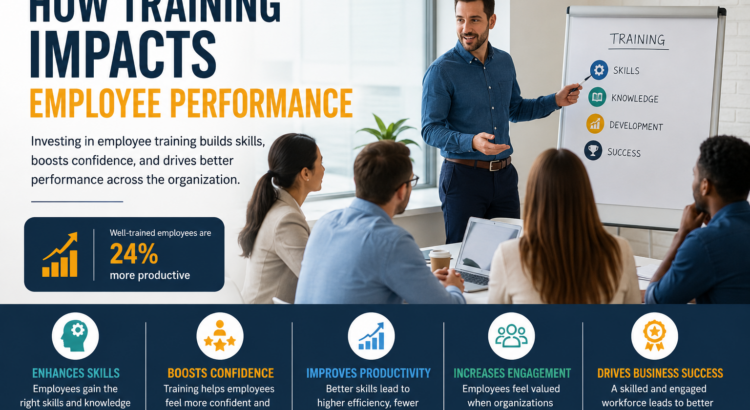
How Training Impacts Employee Performance
In today’s fast-changing business environment, organizations cannot rely solely on hiring skilled employees. Continuous learning and development have become essential for maintaining productivity, improving employee engagement, and achieving long-term business goals. Companies that invest in employee training often see significant improvements in performance, while those that neglect development programs may struggle with lower productivity, higher turnover, and skill gaps.
Employee training is no longer just an HR initiative—it is a strategic investment that directly influences business success. From enhancing technical expertise to boosting confidence and motivation, effective training programs create a workforce that is capable, adaptable, and committed to organizational growth.
Why Training Matters for Employee Performance
Training equips employees with the knowledge, skills, and tools they need to perform their jobs effectively. As industries evolve and technologies change, employees must continuously update their skills to remain productive and competitive.
When training aligns with business objectives, employees gain practical skills that improve their daily performance. They become more efficient, make fewer mistakes, and contribute more effectively to team and organizational goals. Research consistently shows that organizations with strong learning cultures are better positioned to adapt to change and maintain high performance levels.
For additional insights into workplace learning trends, organizations can explore resources from the Association for Talent Development (ATD).
Key Ways Training Improves Employee Performance
1. Enhances Skills and Knowledge
One of the most obvious benefits of training is improved skill development. Whether employees are learning new software, industry regulations, or leadership techniques, training helps them stay current and effective in their roles.
Employees who possess updated knowledge can complete tasks more accurately and efficiently. This reduces errors, improves work quality, and helps organizations maintain a competitive advantage.
2. Increases Employee Confidence
Confidence plays a major role in workplace performance. Employees who understand their responsibilities and have the necessary skills are more likely to make informed decisions and take initiative.
Training programs help employees feel prepared for their roles, reducing uncertainty and increasing their willingness to tackle challenges. As confidence grows, so does productivity and overall job satisfaction.
3. Improves Productivity
Well-trained employees require less supervision and can perform tasks more efficiently. They understand processes, use tools effectively, and spend less time correcting mistakes.
Organizations that invest in employee development often experience higher productivity because employees can focus on achieving results rather than struggling with knowledge gaps.
4. Boosts Employee Engagement
Employees are more engaged when they feel their employer is invested in their professional growth. Training opportunities demonstrate that the organization values its workforce and wants to support career development.
Engaged employees are typically more motivated, committed, and willing to contribute beyond their basic job requirements. This creates a positive workplace culture that benefits both employees and employers.
5. Encourages Adaptability and Innovation
Modern workplaces are constantly evolving. New technologies, market conditions, and customer expectations require employees to adapt quickly.
Training helps employees develop problem-solving skills and adaptability, enabling them to respond effectively to changing circumstances. Organizations with adaptable employees are better equipped to innovate and remain competitive.
The Hidden Costs of Neglecting Employee Training
While the benefits of training are substantial, the consequences of neglecting employee development can be equally significant.
Reduced Productivity
Employees who lack proper training often struggle to complete tasks efficiently. This can result in missed deadlines, lower output, and decreased overall performance.
Increased Errors and Customer Dissatisfaction
Knowledge gaps frequently lead to mistakes that impact product quality, service delivery, and customer satisfaction. Over time, these issues can damage a company’s reputation and reduce customer loyalty.
Higher Employee Turnover
A lack of development opportunities is one of the leading reasons employees leave organizations. When employees feel their growth is being ignored, they are more likely to seek opportunities elsewhere.
According to workforce development experts, providing learning opportunities can significantly improve employee retention and reduce recruitment costs.
Difficulty Adapting to Change
Organizations that fail to train employees often struggle when implementing new technologies, processes, or business strategies. This resistance to change can slow growth and reduce competitiveness.
Best Practices for Effective Training Programs
To maximize training impact, organizations should follow several key principles:
- Align training initiatives with business objectives.
- Identify specific skill gaps through performance assessments.
- Provide ongoing learning opportunities rather than one-time training sessions.
- Incorporate practical, job-related learning experiences.
- Measure training effectiveness using performance metrics and employee feedback.
- Encourage managers to support continuous learning and development.
Businesses can also explore evidence-based learning strategies through resources provided by SHRM (Society for Human Resource Management).
Measuring the Impact of Training on Performance
Training effectiveness should not be measured solely by course completion rates. Organizations should evaluate whether learning leads to meaningful performance improvements.
Common metrics include:
- Productivity improvements
- Error reduction rates
- Employee retention levels
- Customer satisfaction scores
- Time-to-competency for new employees
- Employee engagement survey results
By connecting training outcomes to business goals, organizations can better understand the return on their learning investments and continuously improve their development strategies.
FAQs
How does training improve employee performance?
Training improves employee performance by enhancing skills, increasing confidence, reducing errors, and enabling employees to perform their tasks more efficiently.
Why is employee training important for business success?
Employee training supports productivity, engagement, innovation, and retention. It helps organizations build a skilled workforce capable of achieving business objectives.
What happens when companies neglect employee training?
Companies that neglect training often face lower productivity, higher turnover, increased errors, reduced employee engagement, and difficulty adapting to industry changes.
How can organizations measure training effectiveness?
Organizations can measure effectiveness through productivity metrics, employee retention rates, customer satisfaction scores, performance evaluations, and skill assessments.
Does training help with employee retention?
Yes. Employees are more likely to stay with organizations that invest in their professional growth and provide opportunities for career advancement.
Final Thoughts
Employee training is one of the most powerful tools organizations can use to improve workforce performance and achieve sustainable growth. Beyond enhancing skills, effective training increases confidence, engagement, adaptability, and job satisfaction. At the same time, it helps businesses reduce turnover, improve productivity, and remain competitive in a rapidly evolving market.
Organizations that view training as a long-term investment rather than a short-term expense are more likely to build high-performing teams capable of driving business success. By aligning learning initiatives with organizational goals and continuously measuring results, companies can create a culture of growth that benefits both employees and the business as a whole.