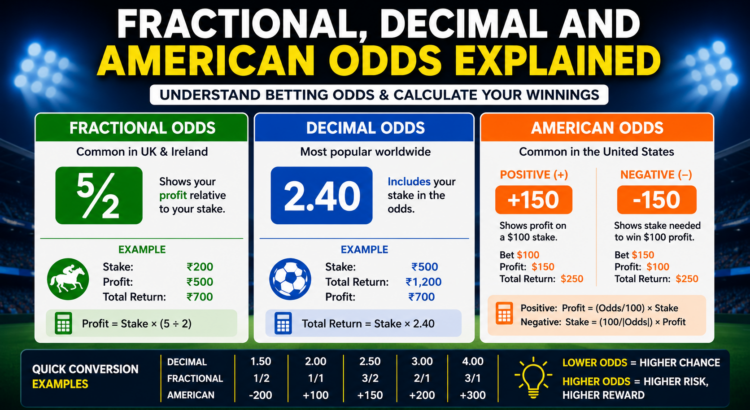
If you’ve ever explored sports betting, you’ve probably come across different odds formats that look confusing at first glance. One website may display 2.50, another shows 3/2, while another lists +150. Although they appear different, they all represent the same thing—your potential payout and the implied probability of an outcome.
Understanding betting odds is one of the most important skills for beginners. Once you know how each format works, comparing markets becomes much easier, and you’ll make more informed betting decisions instead of relying on guesswork.
In this guide, we’ll explain fractional, decimal, and American odds in simple language with practical examples.
What Are Betting Odds?
Betting odds represent two things:
- The amount you can win from a successful bet.
- The bookmaker’s estimated probability of an event happening.
Odds are simply different ways of expressing the same information. Depending on the country or betting platform, you’ll encounter one of three popular formats:
- Fractional Odds
- Decimal Odds
- American Odds
Knowing how to read each format allows you to compare prices across sportsbooks more effectively.
1. Fractional Odds Explained
Fractional odds are traditionally used in the United Kingdom and Ireland. They are written as fractions such as:
- 2/1
- 5/2
- 7/4
- 10/3
How They Work
The first number shows your profit relative to the second number.
For example:
Odds: 5/2
If you stake ₹200, your profit will be:
₹200 × (5 ÷ 2) = ₹500
Your total return becomes:
- Profit: ₹500
- Stake: ₹200
- Total Return: ₹700
Fractional odds focus mainly on the profit, making them popular among experienced horse racing bettors.
Advantages
- Easy to calculate profit.
- Common in UK horse racing.
- Widely recognized by traditional bookmakers.
Disadvantages
- Less intuitive for beginners.
- Comparing different prices takes a little practice.
2. Decimal Odds Explained
Decimal odds are the most widely used format worldwide. Countries across Europe, Australia, Canada, and many Asian sportsbooks prefer decimal pricing.
Examples include:
- 1.80
- 2.00
- 2.75
- 4.50
How They Work
Decimal odds include your original stake.
Formula:
Total Return = Stake × Decimal Odds
Example:
Stake = ₹500
Odds = 2.40
Return:
₹500 × 2.40 = ₹1,200
Profit:
₹1,200 − ₹500 = ₹700
Because the calculation is straightforward, decimal odds are considered the easiest format for beginners.
Advantages
- Very simple calculations.
- Easy to compare odds across bookmakers.
- Most popular international format.
Disadvantages
- Can feel unfamiliar if you’re used to fractional odds.
3. American Odds Explained
American odds are commonly used in the United States.
They appear as positive or negative numbers.
Examples:
- +150
- +250
- -120
- -180
The plus or minus sign changes how the odds are interpreted.
Positive Odds (+)
Positive odds show how much profit you’d earn from a $100 stake.
Example:
+200
Bet $100
Profit = $200
Total Return = $300
Negative Odds (-)
Negative odds show how much you must stake to win $100 profit.
Example:
-150
You need to bet $150
Profit = $100
Total Return = $250
Negative odds usually indicate the favorite, while positive odds often represent the underdog.
Advantages
- Popular for US sports.
- Clearly distinguishes favorites and underdogs.
Disadvantages
- Slightly more difficult for beginners.
- Requires different calculations for positive and negative odds.
Quick Comparison
| Odds Format | Example | Best Used In | Beginner Friendly |
| Fractional | 5/2 | UK & Ireland | Moderate |
| Decimal | 3.50 | Europe, Asia, Australia | Excellent |
| American | +250 / -150 | United States | Moderate |
Converting Between Odds Formats
Here is a simple comparison showing equivalent odds.
| Decimal | Fractional | American |
| 1.50 | 1/2 | -200 |
| 2.00 | 1/1 | +100 |
| 2.50 | 3/2 | +150 |
| 3.00 | 2/1 | +200 |
| 4.00 | 3/1 | +300 |
Learning these common conversions helps when comparing offers across different sportsbooks.
Why Understanding Odds Matters
Many beginners only focus on potential winnings. However, odds also indicate how likely an outcome is according to the bookmaker.
For example:
- Lower odds generally suggest a higher probability.
- Higher odds indicate a less likely outcome but offer larger potential returns.
Knowing this helps bettors evaluate whether a market offers genuine value rather than simply choosing the biggest payout.
If you’re new to sports betting and want to understand betting strategies, market types, and responsible wagering in more detail, you can explore this comprehensive sports betting guide for additional beginner-friendly resources.
Common Mistakes Beginners Make
Many new bettors make avoidable mistakes when reading odds.
Some of the most common include:
- Confusing total returns with profit.
- Ignoring implied probability.
- Comparing odds in different formats without converting them.
- Assuming higher odds always offer better value.
- Forgetting to calculate potential returns before placing a bet.
Taking a few extra seconds to understand the odds can help you make more informed betting decisions.
FAQs
Which betting odds format is easiest to understand?
Decimal odds are generally the easiest because calculating your total return only requires multiplying your stake by the displayed odds.
Are all three odds formats equal?
Yes. Fractional, decimal, and American odds all represent the same probability and payout. They simply display the information differently.
Which countries mainly use fractional odds?
Fractional odds are most commonly used in the United Kingdom and Ireland, especially for horse racing.
Why are American odds sometimes negative?
Negative American odds indicate the favorite. They show how much money you need to stake to earn a profit of $100.
Can I switch odds formats on betting websites?
Most modern sportsbooks allow users to choose between decimal, fractional, and American odds through their account or display settings.
Which odds format do most international sportsbooks use?
Decimal odds are the global standard and are used by the majority of sportsbooks outside the United States.
Final Thought
Understanding fractional, decimal, and American odds is one of the first steps toward becoming a smarter bettor. Although each format looks different, they all communicate the same information in unique ways. Once you become comfortable converting and interpreting odds, comparing betting markets becomes much easier, helping you identify better value and make more informed decisions.
Whether you’re placing your first bet or improving your betting knowledge, mastering odds is a skill that will benefit every future wager. By combining a solid understanding of odds with responsible bankroll management and careful research, you’ll build a stronger foundation for long-term betting success.